
Lesson 1
Part 1: Greetings and Farewells
1. Explanation: In this lesson, we’ll focus on greetings and farewells, which are essential for starting and ending conversations. Mastering these phrases is crucial for making a positive first impression and concluding interactions politely.
2. Useful Phrases:
- Greetings:
- Hello
- Hi
- Hey
- Good morning
- Good afternoon
- Good evening
- Farewells:
- Goodbye
- Bye
- See you later
- See you soon
- Take care
- Have a great day
3. Sample Dialogue:
Context: Two colleagues meet in the morning at the office.
- A: Good morning!
- B: Hi there! How are you?
- A: I’m good, thank you. How about you?
- B: I’m doing well, too. Have a great day!
- A: You too! Goodbye.
4. Fill in the Blank Dialogue:
Fill in the blanks with the appropriate greetings or farewells.
- A: ________!
- B: Hi! How __________ you?
- A: I’m good, thank __________. __________ about you?
- B: I’m doing well, too. ________ a great day!
- A: You ________! ________.
5. Practice:
- Role-Play:
- Pair up with a friend or use a mirror to practice the dialogue. Take turns being person A and person B.
- Real-Life Application:
- Throughout the day, consciously use different greetings and farewells in appropriate situations.
6. Reflection:
Reflect on how using varied greetings and farewells affects your daily interactions. Notice the positive impact on your communication and the responses you receive.
7. Additional Challenge:
Try incorporating these phrases in different social contexts such as with neighbors, friends, or even strangers. This will help you become more comfortable using these expressions in various situations.
Remember, the key to mastering greetings and farewells is practice and repetition. Use these phrases consistently, and soon they will become second nature in your everyday conversations.
Part 2: Basic Personal Information
1. Explanation: In this lesson, we’ll cover the basics of sharing personal information. Being able to introduce yourself and discuss fundamental details such as your name, nationality, and other basic information is essential in any language.
2. Useful Phrases:
- Introducing Yourself:
- My name is…
- I’m…
- Let me introduce myself…
- Allow me to introduce myself…
- Nationality:
- I am from…
- I come from…
- I hold nationality…
- I am [nationality].
- Additional Information:
- I am [age] years old.
- My birthday is on [date].
- I currently live in…
3. Sample Dialogue:
Context: Two new acquaintances meet at a social event.
- A: Hi! I don’t think we’ve met before. Let me introduce myself. My name is Alex.
- B: Nice to meet you, Alex. I’m Sarah. Where are you from?
- A: I’m originally from Canada, but I currently live in New York.
- B: Oh, that’s interesting. I’m from England. How old are you, if you don’t mind me asking?
- A: Not at all. I’m 28. How about you?
- B: I’m 25. It’s great getting to know you!
4. Fill in the Blank Dialogue:
Fill in the blanks with the appropriate phrases.
- A: Hi! ________ introduce myself. ________ John.
- B: Nice to meet you, John. I’m Maria. Where ________ you from?
- A: I’m ________ from Brazil, but ________ live in London now.
- B: Oh, that’s interesting. ________ old are you?
- A: ________ 32. ________ about you?
- B: ________ 27. It’s great ________ to know you!
5. Practice:
- Role-Play:
- Practice the dialogue with a partner, taking turns being person A and person B.
- Real-Life Application:
- Apply the phrases you’ve learned in real-life situations, like introducing yourself to new people or in language exchange activities.
6. Reflection:
Reflect on how comfortable you feel sharing basic personal information. Note any areas that need improvement and continue practicing.
7. Additional Challenge:
Try expanding your introduction by adding more details about your hobbies, interests, or profession. This will help you engage in more extended conversations about yourself.
Remember, effective communication often begins with a clear and confident introduction. Regular practice will enhance your ability to share basic personal information seamlessly.
Part 3: Simple Questions and Answers
1. Explanation: In this lesson, we’ll focus on constructing and responding to simple questions. Mastering basic interrogative structures is crucial for engaging in meaningful conversations and getting to know others.
Understanding question words and when to use each is fundamental to effective communication. Here’s a detailed explanation of common question words:
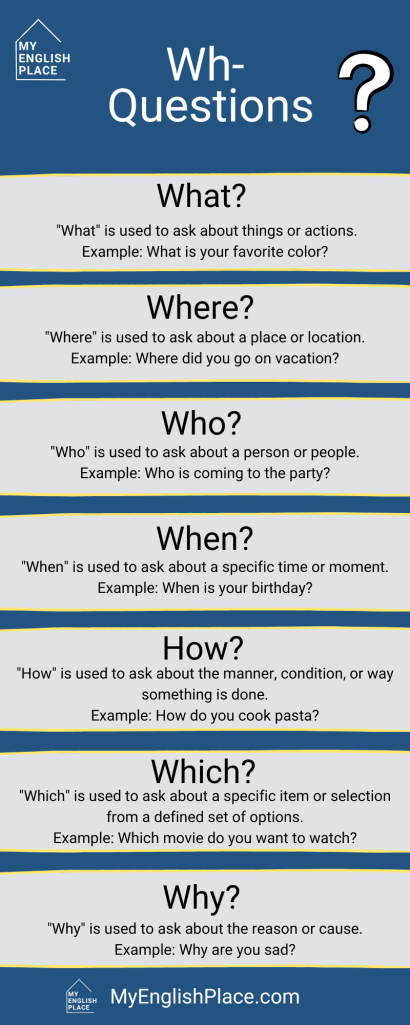
1. What:
- Usage:
- For asking about things, objects, or actions.
- What is your name?
- What do you do for a living?
- What is your favorite color?
- For asking about things, objects, or actions.
2. Where:
- Usage:
- For asking about places or locations.
- Where are you from?
- Where do you live?
- Where is the nearest cafe?
- For asking about places or locations.
3. When:
- Usage:
- For asking about time or specific moments.
- When is your birthday?
- When does the movie start?
- When did you last visit your hometown?
- For asking about time or specific moments.
4. Who:
- Usage:
- For asking about people or identifying individuals.
- Who is your best friend?
- Who won the award?
- Who is coming to the party?
- For asking about people or identifying individuals.
5. How:
- Usage:
- For asking about the manner or method of doing something.
- How do you like to spend your weekends?
- How did you learn to play the guitar?
- How are you feeling today?
- For asking about the manner or method of doing something.
- Usage:
- For asking about quantity, degree, or condition.
- How much does it cost?
- How many siblings do you have?
- How old are you?
- For asking about quantity, degree, or condition.
6. Why:
- Usage:
- For asking about reasons or explanations.
- Why did you choose this career?
- Why are you late?
- Why do you like that movie?
- For asking about reasons or explanations.
7. Whose:
- Usage:
- For asking about possession or ownership.
- Whose car is this?
- Whose idea was it to go on a trip?
- Whose book is on the table?
- For asking about possession or ownership.
8. Which:
- Usage:
- For asking about a specific item or choice among alternatives.
- Which movie do you want to watch?
- Which color do you prefer?
- Which restaurant are we going to?
- For asking about a specific item or choice among alternatives.
Remember, the choice of question word depends on the information you are seeking. By using the appropriate question word, you can make your queries clear and specific, leading to more effective communication. Practice asking and answering questions with these words to become more confident in using them in various contexts.
2. Useful Phrases:
- Question Words:
- What
- Where
- When
- Who
- How
- Simple Questions:
- What is your name?
- Where are you from?
- When is your birthday?
- Who is your favorite actor?
- How are you?
- Simple Answers:
- My name is…
- I’m from…
- My birthday is on…
- My favorite actor is…
- I’m fine/good, thank you.
3. Sample Dialogue:
Context: Two friends catching up after a long time.
- A: Hey! Long time no see. How have you been?
- B: I’ve been good, thanks! What about you?
- A: Not bad. By the way, what’s your favorite book?
- B: Oh, I love reading mystery novels. How about you?
- A: I’m into science fiction. Who’s your favorite author?
4. Fill in the Blank Dialogue:
Fill in the blanks with the appropriate questions or answers.
- A: Hi there! ________ been a while. ________ you?
- B: I’ve ________ good, thanks! ________ about you?
- A: ________ bad. ________ your favorite movie?
- B: I really like comedies. ________ about you?
- A: I enjoy action films. ________ your favorite actor?
5. Practice:
- Role-Play:
- Practice the dialogue with a partner, taking turns being person A and person B. Create variations by changing the questions and answers.
- Real-Life Application:
- Ask simple questions to friends or family members, and respond to their questions. Try to incorporate the question words into everyday conversations.
6. Reflection:
Reflect on your ability to ask and answer simple questions. Notice any areas that require improvement and focus on enhancing those aspects.
7. Additional Challenge:
Challenge yourself by creating new questions related to various topics. Expand your conversational repertoire by asking questions about hobbies, travel, or personal experiences.
Remember, asking and answering questions is a fundamental aspect of communication. Regular practice will build your confidence in engaging with others through simple inquiries.
Part 4: Listening Practice
Listen to the audio of these short dialogues then answer the questions that follow. Check your understanding with the answer key that follows.
Listening 1:
Comprehension Questions:
- What is the name of the person who initiates the conversation?
- How does Alex respond to Sarah’s introduction?
- How does the conversation end?
Listening 2:
Comprehension Questions:
- Where does Chris come from?
- What is Emily’s nationality?
- How old are Chris and Emily?
Listening 3:
Comprehension Questions:
- What is the initial greeting in the conversation?
- How does B respond to A’s question about favorite color?
- What is A’s favorite color?
Answer Key and Scripts: Listening Exercise
Audio Script 1: Introductions and Greetings
Script:
A: Hi, my name is Sarah. Nice to meet you!
B: Hello, Sarah. I’m Alex. How are you today?
A: I’m doing well, thank you. How about you?
B: I’m good too. Have a great day!
A: You too! Goodbye.
- What is the name of the person who initiates the conversation?
- Answer: Sarah.
- How does Alex respond to Sarah’s introduction?
- Answer: Alex says, “Hello, Sarah. I’m Alex. How are you today?”
- How does the conversation end?
- Answer: Sarah and Alex exchange good wishes, and the conversation ends with “You too! Goodbye.”
Audio Script 2: Basic Personal Information
Script:
A: Hey, my name is Chris. I come from Australia.
B: That’s cool, Chris. I’m Emily, and I’m from Canada. How old are you?
A: I’m 25. What about you?
B: I’m 28. Nice to meet you!
- Where does Chris come from?
- Answer: Australia.
- What is Emily’s nationality?
- Answer: Emily is from Canada.
- How old are Chris and Emily?
- Answer: Chris is 25, and Emily is 28.
Audio Script 3: Simple Questions and Answers
Script:
A: Hi there! How have you been?
B: I’ve been good, thanks! What about you?
A: Not bad. By the way, what’s your favorite color?
B: Oh, I love blue. How about you?
A: I prefer green.
- What is the initial greeting in the conversation?
- Answer: “Hi there! How have you been?”
- How does B respond to A’s question about favorite color?
- Answer: B says, “Oh, I love blue.”
- What is A’s favorite color?
- Answer: A prefers green.
Lesson 2
Part 1: Daily Routines and Present Simple Tense
1. Explanation: In this lesson, we’ll dive into daily routines and how to express them using the present simple tense. The present simple tense is used to describe habitual actions, routines, and general truths.
2. Present Simple Tense:
- Structure:
- Affirmative: Subject + Verb (base form) + Object.
- Example: I wake up early every day.
- Negative: Subject + Do/Does + Not + Verb (base form) + Object.
- Example: I do not watch TV in the morning.
- Interrogative: Do/Does + Subject + Verb (base form) + Object?
- Example: Do you have breakfast every day?
- Affirmative: Subject + Verb (base form) + Object.
- Rules:
- Use the base form of the verb for all subjects except third person singular (he, she, it), where you add -s or -es to the verb.
- Example: She eats breakfast at 8 AM.
- For negative sentences and questions, use the auxiliary verb “do” (for I, you, we, they) or “does” (for he, she, it).
- Example (Negative): We do not go to bed late.
- Example (Question): Does he exercise every morning?
- Use the base form of the verb for all subjects except third person singular (he, she, it), where you add -s or -es to the verb.
3. Short Texts:
Text 1: “My daily routine is quite simple. I wake up at 6 AM, have a quick shower, and then prepare breakfast. I leave for work at 8 AM. In the evening, I usually go for a jog before dinner. I go to bed around 10:30 PM.”
Text 2: “Every morning, Sarah wakes up and stretches. She makes a cup of coffee and reads the news before heading to work. She usually has lunch at a nearby café. In the evening, she attends a yoga class and relaxes with a book before going to sleep at 11 PM.”
4. Conversation Questions:
- What time do you usually wake up in the morning?
- Describe your morning routine.
- What is the first thing you do when you wake up?
- Describe your evening routines?
- What time do you usually go to bed?
5. Practice:
- Create Sentences:
- Practice describing your daily routine using the present simple tense.
- Creat Sentences Part 2:
- Write a short paragraph describing the morning and evening routines you see in the pictures below. First write them in first person, like it is your routine. Next, try writing them in the third person. You can check sample answers at the end of the lesson.
- Role-Play:
- Engage in a conversation with a language partner, discussing your daily routines and asking about theirs.
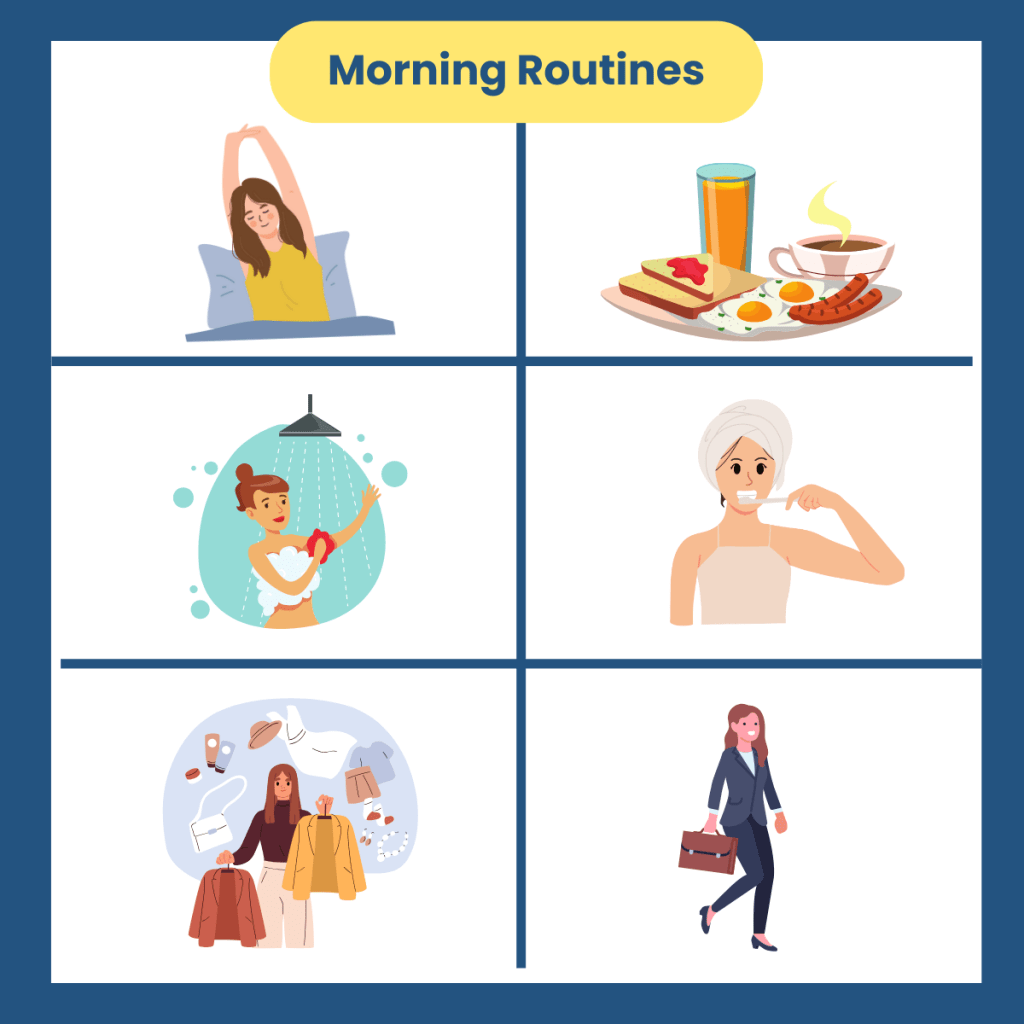
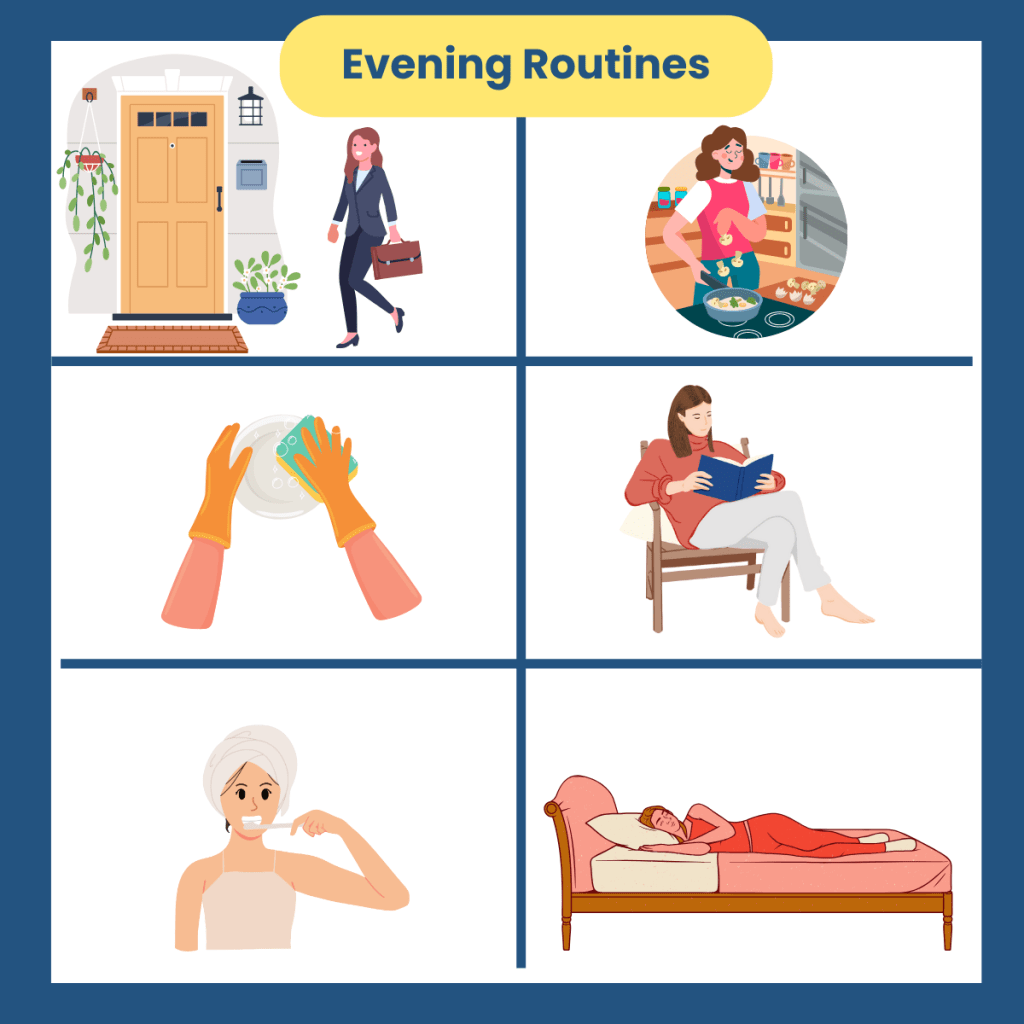
6. Real-Life Application:
- Use the present simple tense to talk about your daily routines in everyday conversations or when making plans.
7. Reflection:
- Reflect on how using the present simple tense helps convey the regularity of daily activities. Note any new words or expressions you’ve learned.
8. Additional Challenge:
- Challenge yourself by incorporating adverbs of frequency (always, usually, often, sometimes, rarely, never) into your descriptions of daily routines.
Sample Answers for Exercise 5
Morning Routine:
Every morning, I wake up at 7 AM. First, I eat breakfast – usually, it’s oats and coffee. Then, I take a shower and brush my teeth. After that, I get dressed and go to work. That’s my morning routine!
Evening Routine:
After work, I come home. First, I cook dinner, and then I wash the dishes. Next, I read a book to relax. Before bed, I brush my teeth, and finally, I go to bed. That’s my evening routine!
Morning Routine- third person:
Every morning, she wakes up at 7 AM. First, she eats breakfast – usually, it’s oats and coffee. Then, she takes a shower and brushes her teeth. After that, she gets dressed and goes to work. That’s her morning routine!
Evening Routine- third person:
After work, she comes home. First, she cooks dinner, and then she washes the dishes. Next, she reads a book to relax. Before bed, she brushes her teeth, and finally, she goes to bed. That’s her evening routine!
Part 2: Adverbs of Frequency and Daily Activities
1. Explanation: In this lesson, we’ll explore adverbs of frequency, words that describe how often an action occurs. Understanding these adverbs enhances your ability to express the regularity of daily activities.
2. Adverbs of Frequency:
- Common Adverbs:
- Always, usually, often, sometimes, rarely, never.
- Position in Sentence:
- Place adverbs of frequency before the main verb but after the auxiliary verb (if present).
- Example: She always reads before bedtime.
- Example (Negative): I never skip breakfast.
- Place adverbs of frequency before the main verb but after the auxiliary verb (if present).
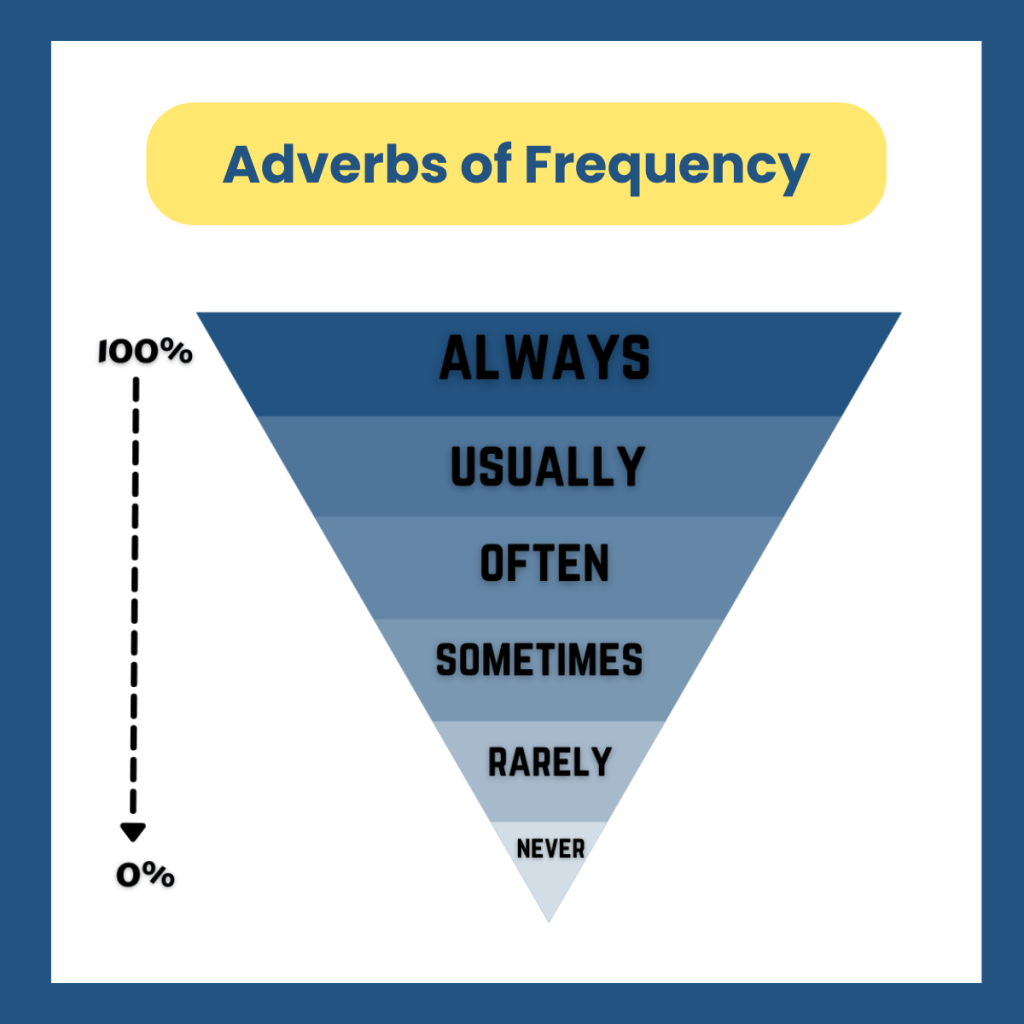
3.Texts:
Text 1: “I always start my day with a cup of tea. I usually check my emails in the morning. After that, I often go for a short walk. Sometimes, I meet friends for lunch. In the evening, I rarely watch TV, and I never go to bed without reading a book.”
Text 2: “He rarely misses his morning jog. He sometimes works late at the office. On weekends, he often visits his family. He usually cooks dinner for himself. He never forgets to call his parents. They always appreciate his calls.”
4. Conversation Questions:
- What activities do you always do in the morning?
- How often do you usually check your emails?
- How often do you go shopping?
- Do you sometimes meet friends for lunch?
- What activities do you rarely do in the evening?
5. Practice:
- Create Sentences:
- Practice using adverbs of frequency to describe your daily activities.
- Create Sentences Part 2:
- Look at the image below and create sentences about how often you do each activity.
- Role-Play:
- Engage in a conversation with a language partner, discussing your daily routine and using adverbs of frequency.

6. Real-Life Application:
- Use adverbs of frequency when talking about your habits and routines in everyday conversations.
7. Reflection:
- Reflect on how using adverbs of frequency provides clarity and precision in describing how often you engage in different activities. Identify any new words or expressions you’ve learned.
8. Additional Challenge:
- Challenge yourself by incorporating a variety of adverbs of frequency into more complex sentences or by describing the routines of others.
Part 3: Talking About Daily Activities
1. Explanation: In this lesson, we’ll focus on conversational language for discussing daily activities. We’ll also review the use of adverbs of frequency to provide information about how often these activities take place.
2. Talking About Daily Activities:
- Common Expressions:
- In the morning, in the afternoon, in the evening.
- Daily routine phrases: Wake up, get ready, go to work, have lunch, relax, have dinner, go to bed.
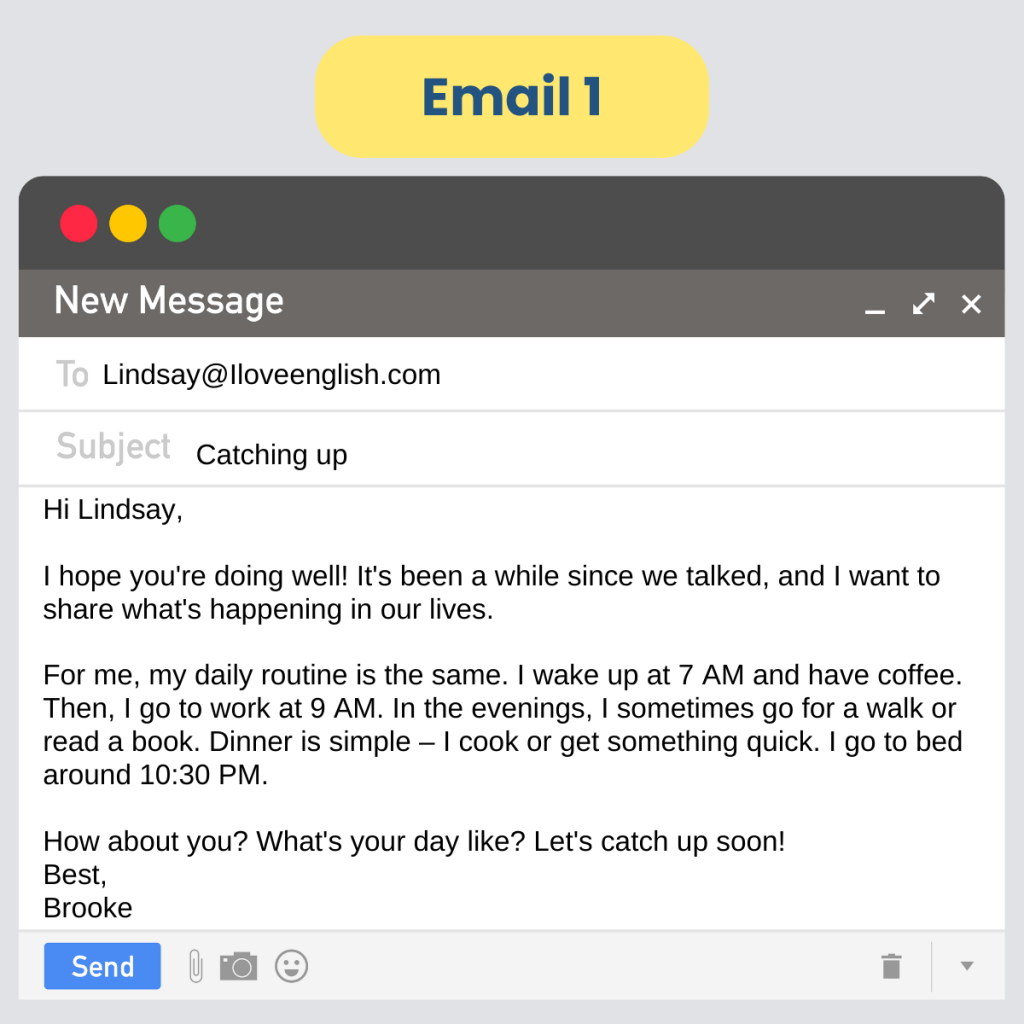
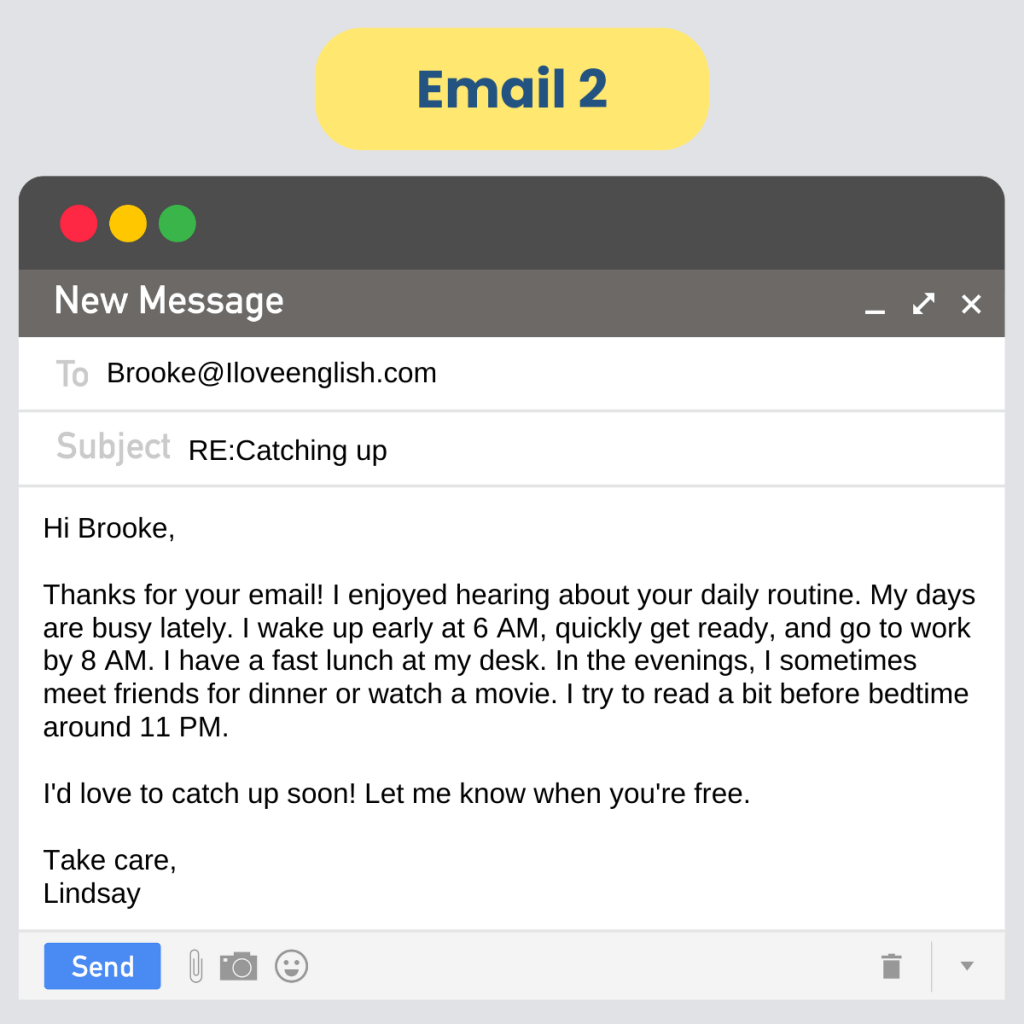
3. Friendly Email and Reply:
Read the emails below and try to write your own email to a friend describing your daily routines.
Email 1:
Reply:
4. Reflection:
- Consider how adverbs of frequency enhance the information shared in the email and reply. Reflect on the similarities and differences in the daily routines of the two friends.
5. Real-Life Application:
- Use similar expressions and adverbs of frequency when communicating about your daily activities in emails, messages, or conversations.
6. Additional Challenge:
- Challenge yourself by incorporating more specific details into your descriptions and asking follow-up questions to deepen the conversation.
Part 4: Listening Practice:
Listen to the audio of these short dialogues then answer the questions that follow. Check your understanding with the answer key that follows.
Listening 1:
Comprehension Questions:
- What time does Sarah usually wake up?
- What does she always start her morning with?
- Does Sarah ever skip breakfast?
- When does she usually leave for work?
Listening 2:
Comprehension Questions:
- Where does Alex often have lunch during the workweek?
- What does he sometimes do after lunch?
- When does Alex usually finish work?
- What does he rarely do in the evenings?
Listening 3:
Comprehension Questions:
- What does Emma always do on weekends regarding waking up?
- How does she usually start her weekend mornings?
- What does Emma sometimes do in the afternoons?
- What does she rarely do regarding dinner on weekends?
Listening 4:
Comprehension Questions:
- What time does Tom usually wake up?
- Does he sometimes eat at his desk during lunchtime?
- When does Tom often go for a walk or watch a movie?
- What time does he prefer to go to bed?
Answer Key and Scripts: Listening Exercise
Audio Script 1: Morning Routine
Script:
“Good morning! This is Sarah. I usually wake up at 7 AM every day. I always start my morning with a cup of tea. I never skip breakfast; it’s an important meal for me. After breakfast, I sometimes go for a short walk. I usually leave for work around 9 AM. That’s my typical morning routine.”
- What time does Sarah usually wake up?
- Answer: 7 AM.
- What does she always start her morning with?
- Answer: A cup of tea.
- Does Sarah ever skip breakfast?
- Answer: No.
- When does she usually leave for work?
- Answer: Around 9 AM.
Audio Script 2: Afternoon Activities
Script:
“Hello, it’s Alex. I often have lunch at a nearby restaurant during the workweek. Sometimes, I meet friends for a quick chat. I usually finish work around 5 PM. In the evenings, I rarely watch TV. I prefer reading a book or going for a jog. That’s how I spend my afternoons and evenings.”
- Where does Alex often have lunch during the workweek?
- Answer: At a nearby restaurant.
- What does he sometimes do after lunch?
- Answer: Meet friends for a quick chat.
- When does Alex usually finish work?
- Answer: Around 5 PM.
- What does he rarely do in the evenings?
- Answer: Watch TV.
Audio Script 3: Weekend Routine
Script:
“Hi, this is Emma. On weekends, I always sleep in. I never set an alarm. I usually have a big breakfast and spend time with my family. Sometimes, we go for a picnic in the park. In the afternoons, I often do some shopping. I rarely cook dinner on weekends; we usually order food. That’s how I enjoy my weekends.”
- What does Emma always do on weekends regarding waking up?
- Answer: Sleep in.
- How does she usually start her weekend mornings?
- Answer: With a big breakfast and spending time with family.
- What does Emma sometimes do in the afternoons?
- Answer: Some shopping.
- What does she rarely do regarding dinner on weekends?
- Answer: Cook; they usually order food.
Audio Script 4: Daily Tasks
Script:
“This is Tom. He wakes up early at 6 AM every morning. Tom usually has a quick breakfast and rushes to work by 8 AM. At lunchtime, he sometimes eats at his desk. Tom finishes work around 5 PM. In the evenings, he often goes for a walk or watches a movie. Tom rarely stays up late; he prefers going to bed by 10 PM.”
- What time does Tom usually wake up?
- Answer: 6 AM.
- Does he sometimes eat at his desk during lunchtime?
- Answer: Yes.
- When does Tom often go for a walk or watch a movie?
- Answer: In the evenings.
- What time does he prefer to go to bed?
- Answer: By 10 PM.
Lesson 3
Part 1: Numbers 1-20
1. Explanation: In this lesson, we will focus on numbers 1-20. Understanding these numbers is crucial for basic communication, such as giving your age, telling time, or expressing quantities.
2. Numbers 1-20:
- 1 (one)
- 2 (two)
- 3 (three)
- 4 (four)
- 5 (five)
- 6 (six)
- 7 (seven)
- 8 (eight)
- 9 (nine)
- 10 (ten)
- 11 (eleven)
- 12 (twelve)
- 13 (thirteen)
- 14 (fourteen)
- 15 (fifteen)
- 16 (sixteen)
- 17 (seventeen)
- 18 (eighteen)
- 19 (nineteen)
- 20 (twenty)
3. Pronunciation Practice:
- Listen to the correct pronunciation of each number. Pay attention to the stress on syllables.
4. Counting Exercise:
- Practice counting from 1 to 20 and then backward from 20 to 1. Repeat until you feel confident with the numbers.
5. Matching Game:
- Create flashcards with numbers written out in words on one side and numerals on the other. Practice matching them correctly.
6. Vocabulary Expansion:
- Associate each number with common everyday objects or actions. For example, connect “five” with fingers or “ten” with fingers and toes.
7. Time Telling:
- Learn how to tell time using numbers 1-12. Practice saying different times of the day. We will practice this in Part 3 of this lesson.
8. Basic Math:
- Practice simple addition and subtraction using the numbers 1-20. For example, 5 + 3 = ? or 12 – 7 = ?
9. Real-Life Application:
- Use numbers in practical situations, such as giving your phone number, address, or discussing quantities when shopping.
10. Quiz Yourself:
- Create a quiz for yourself with questions like “What is 14 + 6?” or “How do you say 18 in words?” Check your answers and reinforce your understanding.
11. Reflection:
- Reflect on your progress with numbers 1-20. Identify any specific numbers or concepts that require additional practice.
12. Additional Challenge:
- Challenge yourself by incorporating numbers into short sentences. For example, “I have 10 fingers,” or “There are 15 students in the class.”
Remember, consistent practice is key to mastering numbers. Use them in various contexts to reinforce your understanding and increase your comfort with using numbers in everyday situations.
Part 2: “There is/There are” – Basic Vocabulary for Everyday Objects
1. Explanation: In this lesson, we will focus on using the phrases “there is” and “there are” to describe the presence of everyday objects in various settings. This structure is essential for expressing the existence of things and is commonly used in day-to-day communication.
The choice between “there is” and “there are” depends on whether you are talking about a singular or plural noun. Here’s a breakdown:
There is:
- Usage: Use “there is” when you are referring to a singular noun or an uncountable noun (something you cannot easily count).
- Examples:
- There is a cat on the roof.
- There is water in the glass.
- There is a meeting at 3 PM.
- Note: Even if there are multiple items of the same kind, as long as you are referring to them as a single group or concept, you use “there is.”
- There is a group of students in the library.
There are:
- Usage: Use “there are” when you are referring to plural nouns (more than one) or multiple countable items.
- Examples:
- There are three books on the shelf.
- There are many cars in the parking lot.
- There are some interesting movies playing tonight.
- Note: Use “there are” when talking about more than one distinct item or when you can easily count the items individually.
Tips:
- Pay attention to the noun that follows “there is” or “there are” to determine whether it’s singular or plural.
- If you’re unsure about the number of items, focus on whether the noun is countable or uncountable.
Additional Examples:
- Singular (There is): There is a problem with my computer.
- Plural (There are): There are several issues that need to be addressed.
2. Vocabulary:
- Common Nouns:
- Chair, table, book, pen, phone, computer, cup, key, door, window, etc.
- “There is/There are” Phrases:
- There is a chair in the room.
- There are books on the shelf.
- Is there a phone on the table?
- There isn’t a computer in the office.
3. Pronunciation Practice:
- Listen to the correct pronunciation of “there is” and “there are.” Pay attention to the linking of sounds in natural speech.
4. Useful Phrases:
- Describing Existence:
- There is a lamp in the living room.
- There are two cars in the parking lot.
- Is there a mirror in the bathroom?
- There isn’t a television in the bedroom.
- Asking about Existence:
- Are there any chairs in the kitchen?
- Is there a window in your office?
- Are there books on the table?
5. Sample Dialogue:
Context: Two friends discussing their new apartment.
- A: Have you seen the new apartment?
- B: Yes, I have. It’s lovely! There is a spacious living room.
- A: And there are two bedrooms. Is there a kitchen?
- B: Yes, there is. It’s fully equipped.
6. Fill in the Blank Dialogue:
Fill in the blanks with the appropriate words or phrases from the vocabulary list. You can check your answers below.
- A: __________ a desk in the bedroom?
- B: Yes, __________. And __________ a computer on it.
- A: __________ a coffee table in the living room?
- B: No, __________. But __________ a table in the dining room.
- A: ___________ chairs at the dining room table?
- B: Yes, ___________ six chairs at the dining room table.
7. Practice:
- Home Exploration:
- Walk around your home and practice describing the existence of different objects using “there is/there are.”
- Imagination Exercise:
- Close your eyes and imagine a room. Describe the objects in the room using “there is/there are.”
- Question and Answer:
- Create questions about the existence of objects and answer them using the phrases.
8. Real-Life Application:
- Use “there is/there are” when discussing places, such as hotels, restaurants, or public spaces.
9. Reflection:
- Reflect on your ability to use “there is/there are” in describing everyday objects. Note any challenges or areas for improvement.
10. Additional Challenge:
- Challenge yourself by incorporating more complex sentences, such as using prepositions to describe the location of objects.
By actively engaging with “there is/there are” and practicing in different contexts, you’ll become more comfortable expressing the existence of objects in your surroundings. Regular use of these phrases will enhance your ability to communicate effectively in various situations.
Exercise 6 Answers:
- A: Is there a desk in the bedroom?
- B: Yes, there is. And there is a computer on it.
- A: Is there a coffee table in the living room?
- B: No, there isn’t. But there is a table in the dining room.
- A: Are there chairs at the dining room table?
- B: Yes, there are six chairs at the dining room table.
Part 3: Asking and Telling Time
1. Explanation: In this lesson, we’ll focus on the vocabulary and expressions related to asking for and telling time. Being able to communicate time is essential for various daily activities and appointments.
2. Vocabulary:
- Time Phrases:
- Hour, minute, o’clock, quarter past, half past, quarter to.
- Asking for Time:
- What time is it?
- Could you tell me the time, please?
- Do you have the time?
- Telling Time:
- It’s [hour] o’clock.
- It’s quarter past [hour].
- It’s half past [hour].
- It’s quarter to [hour].
3. Pronunciation Practice:
- Listen to the correct pronunciation of time-related phrases. Pay attention to how native speakers express different times.
4. Useful Phrases:
- Asking for Time:
- Excuse me, what time is it?
- Hey, do you have the time?
- Could you tell me what time it is?
- Telling Time:
- It’s 3 o’clock.
- It’s quarter past 9.
- It’s half past noon.
- It’s quarter to 4.
5. Sample Dialogue:
Context: Two friends planning to meet at a café.
- A: Hey, do you know what time it is?
- B: Sure, it’s half past 2. Why?
- A: We were supposed to meet at 3. I still have some time.
6. Fill in the Blank Dialogue:
Fill in the blanks with the appropriate words or phrases from the vocabulary list.
- A: Excuse me, could you __________ me what __________ it is?
- B: Certainly, it’s __________ to 7.
- A: Thanks! I need to leave by __________ past 6.
7. Practice:
Look at this image and answer the question “What time is it?” in full sentences for Part 1 and Part 2.
For example:
Question 1. It’s two o’clock.

Looking at image
- Clock Observation:
- Look at a clock and practice telling the time. Use both digital and analog clocks for variety.
- Role-Play:
- Create scenarios with a partner where you ask for and tell the time in different situations, such as making plans or catching transportation.
- Time Management:
- Plan your day and use the phrases to express your schedule. For example, “I have a meeting at 2 o’clock.”
8. Real-Life Application:
- Practice asking and telling time in real-life situations, such as public transportation schedules, appointments, or meeting friends.
9. Reflection:
- Reflect on your ability to ask for and tell time. Identify any challenges or areas for improvement.
10. Additional Challenge:
- Challenge yourself by incorporating more specific times into your practice. For example, “It’s 5:15.”
By actively engaging with the phrases and practicing in different contexts, you’ll become more confident in asking for and telling time. Regular use of these expressions will make them second nature in your everyday communication.
Answers for Part 7 Practice:
Part 1:
- 2:00
- British English: 2 o’clock
- American English: 2 o’clock
- 8:00
- British English: 8 o’clock
- American English: 8 o’clock
- 10:10
- British English: Ten past ten
- American English: Ten ten
- 2:15
- British English: Quarter past two
- American English: Two fifteen
- 3:55
- British English: Five to four
- American English: Three fifty-five
- 10:54
- British English: Six minutes to eleven
- American English: Ten fifty-four
- 9:00
- British English: 9 o’clock
- American English: 9 o’clock
- 6:00
- British English: 6 o’clock
- American English: 6 o’clock
Part 2:
- 4:15
- British English: Quarter past four
- American English: Four fifteen
- 7:30
- British English: Half past seven
- American English: Seven thirty
- 12:00
- British English: Twelve o’clock (midday)
- American English: Twelve o’clock (noon)
- 2:45
- British English: Quarter to three
- American English: Two forty-five
- 9:10
- British English: Ten past nine
- American English: Nine ten
- 1:05
- British English: Five past one
- American English: One oh-five
- 11:50
- British English: Ten minutes to twelve
- American English: Eleven fifty
- 3:00
- British English: 3 o’clock
- American English: 3 o’clock
Lesson 4
Part 1: Rooms and Furniture
1. Explanation: In this lesson, we’ll focus on vocabulary related to different rooms in a house and common pieces of furniture. Understanding these terms is essential for describing living spaces and expressing preferences in daily conversations.
2. Vocabulary:
- Rooms:
- Living room, bedroom, kitchen, bathroom, dining room, study, etc.
- Furniture:
- Sofa, bed, table, chair, desk, wardrobe, bookshelf, etc.
- For more room and furniture vocabulary and picture dictionaries, check out the Vocabulary section on My English Place. https://myenglishplace.com/vocabulary/
3. Articles (a, an, the):
Articles are words that define a noun as specific or unspecific. In English, there are two types of articles: definite and indefinite.
Definite Article: “The”
- Usage:
- “The” is a definite article, and it is used when we are talking about a specific item or something that is already known to the reader or listener.
- Examples:
- The cat is sitting on the roof.
- I bought a book yesterday. The book is interesting.
- When to Use “The”:
- Use “the” when the noun it modifies is specific and known to both the speaker and the listener.
- Example: Please pass me the salt.
- Use “the” when referring to a specific item mentioned earlier in the conversation.
- Example: I saw a movie yesterday. The movie was really good.
- Use “the” when the noun it modifies is specific and known to both the speaker and the listener.
Indefinite Articles: “A” and “An”
- Usage:
- “A” is used before words that begin with a consonant sound.
- “An” is used before words that begin with a vowel sound.
- Examples:
- I have a car.
- She bought an umbrella.
- When to Use “A” or “An”:
- Use “a” before words that begin with a consonant sound.
- Example: I saw a dog in the park.
- Use “an” before words that begin with a vowel sound.
- Example: She is an honest person.
- Use “a” before words that begin with a consonant sound.
- Note: The choice between “a” and “an” is based on the sound that follows the article, not the actual first letter of the word.
Zero Article:
- Usage:
- Sometimes, no article is used before a noun. This is known as the zero article.
- Examples:
- I like pizza.
- He is studying biology.
- When to Use Zero Article:
- Use zero article when referring to general concepts or things in a broad sense.
- Example: Dogs are loyal animals.
- Use zero article when talking about things in general or making general statements.
- Example: Happiness is important.
- Use zero article when referring to general concepts or things in a broad sense.
Understanding when to use “the,” “a,” “an,” or no article at all depends on whether you are talking about something specific or something more general. Regular practice and exposure to English usage will help you develop an instinct for choosing the correct articles.
4. Useful Phrases:
- Describing Rooms:
- The living room has a comfortable sofa.
- My bedroom is spacious.
- The kitchen is equipped with modern appliances.
- Describing Furniture:
- There is a desk in the study.
- We need a new dining table.
- The bed in the bedroom is very comfortable.
5. Sample Dialogue:
Context: Two friends discussing a new apartment.
- A: Have you seen my new apartment?
- B: Yes, it’s fantastic! I love the living room.
- A: Thank you! The sofa is brand new.
- B: Is there a dining table in the kitchen?
- A: Yes, there is. It’s a small wooden table.
6. Fill in the Blank Dialogue:
Fill in the blanks with the appropriate words or phrases from the vocabulary list, and use the correct articles.
- A: I need __________ new chair for __________ study.
- B: How about __________ comfortable chair with __________ small table?
- A: That sounds good! I also want to get __________ bookshelf for __________ living room.
7. Practice:
- Room and Furniture Identification:
- Label the rooms and furniture in your home using the correct articles.
- Role-Play:
- Create dialogues with a partner where you describe different rooms and furniture items in a house.
- Online Vocabulary Games:
- Play online games or quizzes to reinforce your understanding of room and furniture vocabulary.
- Review the Vocabulary section here on My English Space: There are many picture dictionaries to help you learn room, furniture, and appliance vocabulary. https://myenglishplace.com/vocabulary/
8. Real-Life Application:
- Practice describing your own living space or discussing preferences when it comes to rooms and furniture.
9. Reflection:
- Reflect on your ability to use articles correctly when describing rooms and furniture. Note any challenges or areas for improvement.
10. Additional Challenge:
- Challenge yourself by incorporating more specific details into your descriptions, such as colors or materials of furniture items.
By actively engaging with room and furniture vocabulary and practicing in different contexts, you’ll become more proficient in describing living spaces and expressing preferences in English. Regular use of these words and articles will enhance your ability to communicate effectively.
Part 2: Prepositions of Place
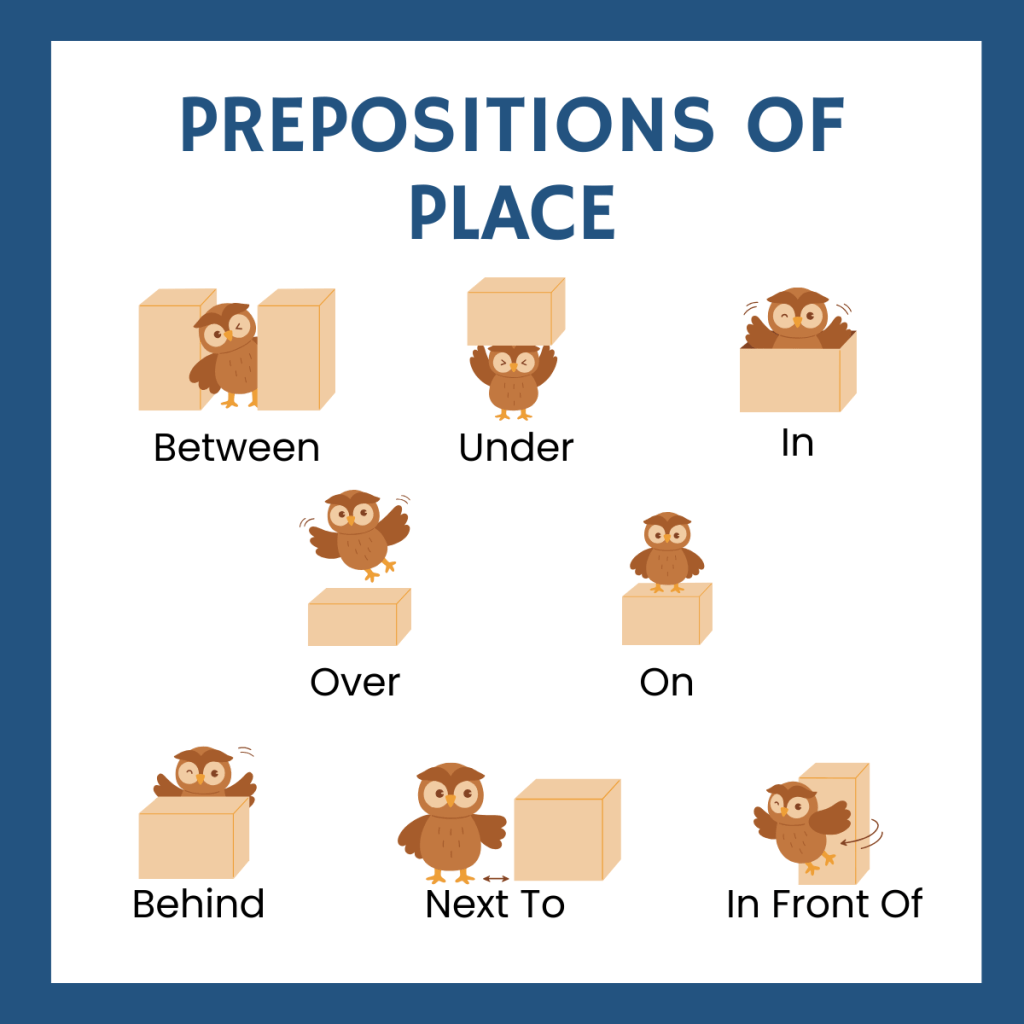
1. Explanation: Prepositions of place describe the location of one thing in relation to another. Understanding and using these prepositions correctly is crucial for providing clear and accurate descriptions of where things are located.
2. Most Used Prepositions of Place:
- In: Used for an enclosed space.
- Example: The cat is in the box.
- On: Used for surfaces.
- Example: The book is on the table.
- Under: Used to denote something below or beneath.
- Example: The shoes are under the bed.
- Next to/Beside: Used to indicate proximity.
- Example: The school is next to the park.
- Between: Used to indicate a position in the middle of two things.
- Example: She is sitting between two friends.
- Behind: Used to indicate something at the back.
- Example: The car is behind the house.
- In front of: Used to indicate something at the front.
- Example: The restaurant is in front of the cinema.
3. How to Use Prepositions of Place:
- Consider the position of the object in relation to other objects or the surroundings.
- Use the appropriate preposition to accurately describe the location.
4. Useful Phrases:
- The cat is in the box.
- The keys are on the table.
- The dog is under the tree.
- The supermarket is next to the bank.
- She is sitting between two friends.
- The car is behind the garage.
- The restaurant is in front of the hotel.
5. Sample Dialogue:
Context: Discussing a new office layout.
- A: Where should we place the new desk?
- B: I think it should go next to the window.
- A: Good idea. And the bookshelf can go in front of the desk.
6. Fill in the Blank Dialogue:
Fill in the blanks with the appropriate prepositions from the list.
- A: The cat is __________ the chair.
- B: The keys are __________ the TV.
- A: The school is __________ the library and the park.
7. Practice:
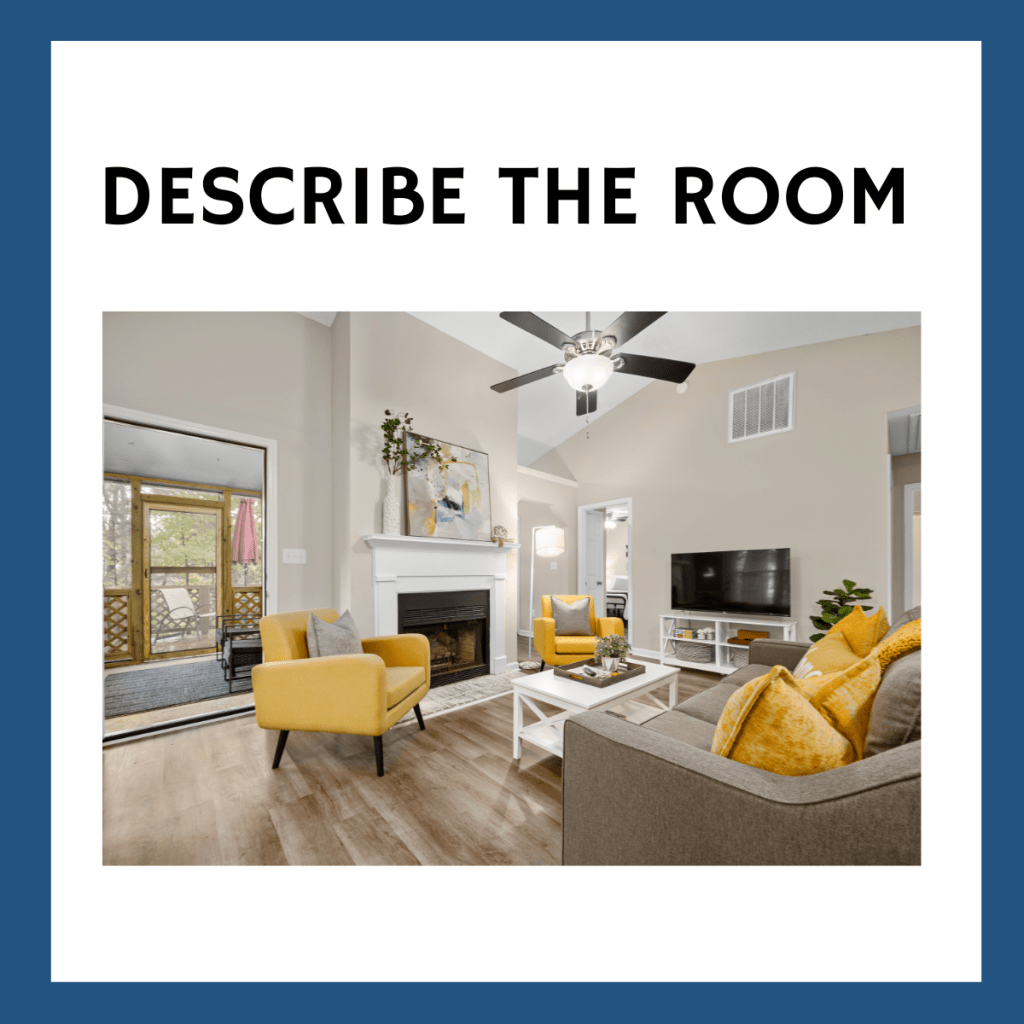
Look at the image below and make 5 sentences about the room using the practiced prepositions of place.
- Object Placement Exercise:
- Place common objects around your room and practice describing their locations using prepositions.
- Drawing Exercise:
- Draw a simple room layout and label the objects using prepositions of place.
- Role-Play:
- Create dialogues with a partner, describing the location of objects in different scenarios.
8. Real-Life Application:
- Use prepositions of place in daily conversations to provide clear and accurate directions or descriptions.
9. Reflection:
- Reflect on your ability to use prepositions of place accurately. Note any challenges or areas for improvement.
10. Additional Challenge:
- Challenge yourself by describing more complex scenes or locations using a variety of prepositions.
Part 3: Describing Your Home
1. Explanation: Describing your home is an essential skill for effective communication. This involves using vocabulary related to rooms, furniture, and prepositions of place to paint a clear picture of your living space.
2. Quick Review of Prepositions of Place:
- In: The cat is in the living room.
- On: The book is on the coffee table.
- Under: The shoes are under the chair.
- Next to/Beside: The lamp is next to the sofa.
- Between: The cushions are between the two pillows.
- Behind: The TV is behind the bookshelf.
- In front of: The mirror is in front of the dresser.
3. Useful Phrases:
- My home has three bedrooms.
- There’s a cozy living room with a fireplace.
- The kitchen is equipped with modern appliances.
- I have a spacious backyard.
- The dining table is next to the kitchen.
4. Sample Text Describing a Room: My living room is a comfortable and inviting space. There is a big grey sofa with colorful cushions. The coffee table is in front of the sofa, with some books and a vase on top. A beautiful painting hangs on the wall above the fireplace. The TV is on the wall opposite the sofa. Next to the TV, there is a bookshelf filled with books and pictures of my family.
5. Fill in the Blank Text: Complete the following text by filling in the blanks with the appropriate prepositions and descriptive words.
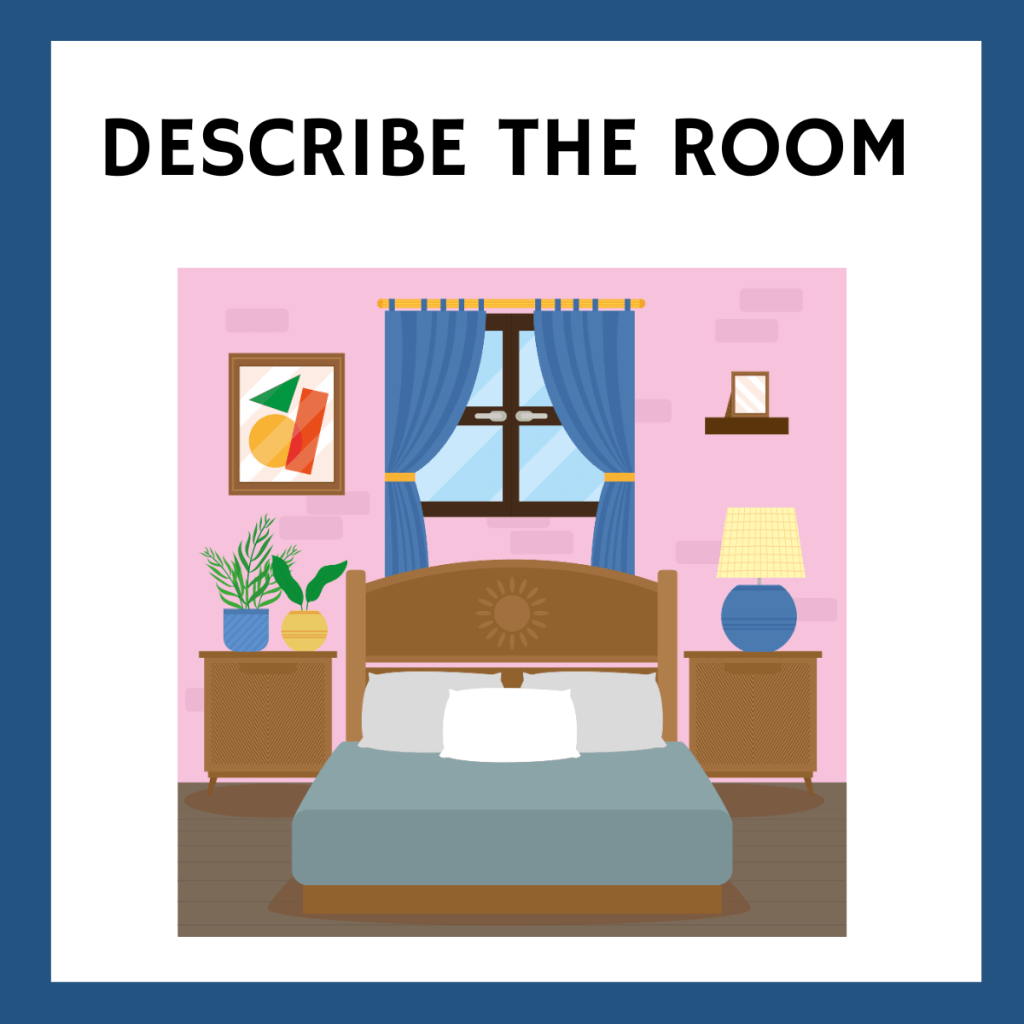
“My bedroom is __________ the second floor. As you walk __________ the door, you’ll see a comfortable bed __________ two nightstands. There’s a lamp __________ one nightstand and two plants __________ the other nightstand. The window is __________ the bed, and the curtains are a lovely shade of blue. There is a painting __________ the window and three pillows __________ the bed. Overall, it’s a cozy and peaceful space.”
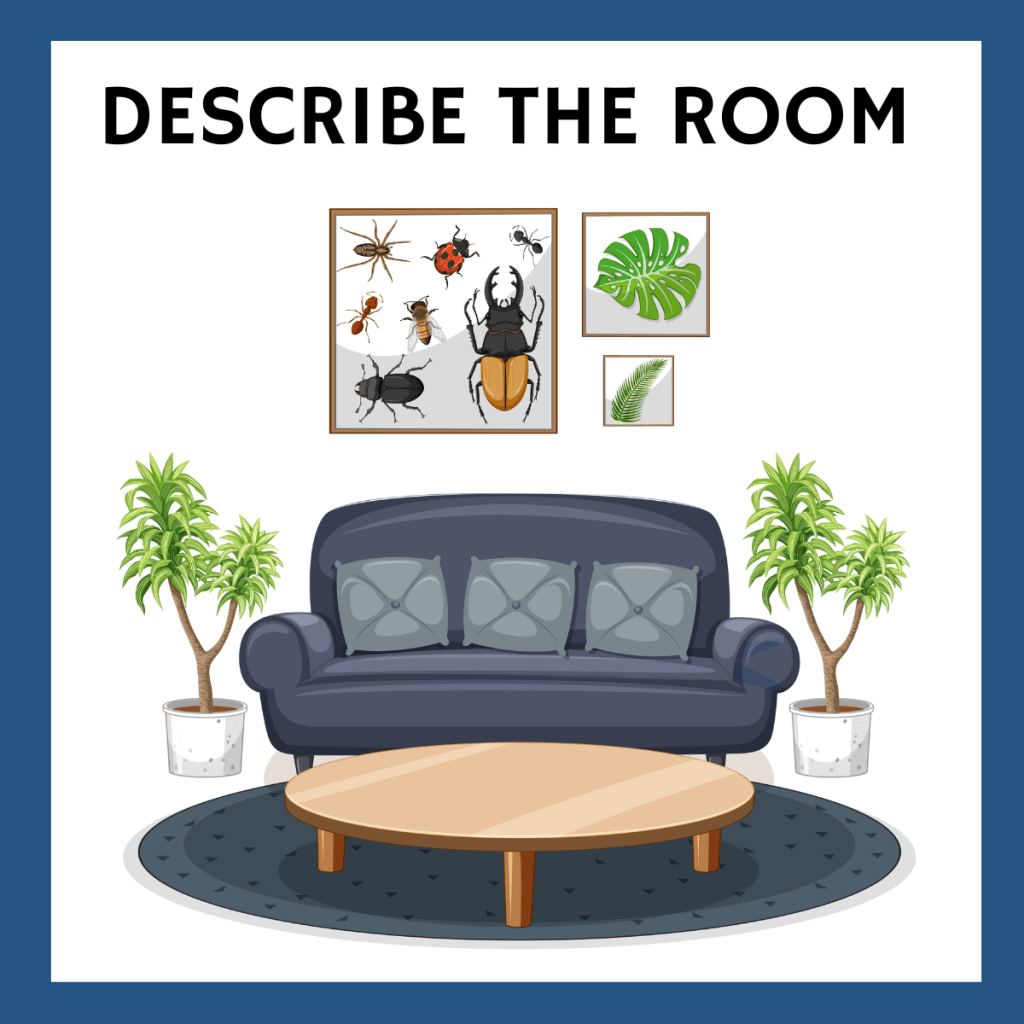
“I love my living room. There is a black sofa __________ two beautiful plants. __________ the sofa, there is a round coffee table and __________ the coffee table, there is a large rug. There are three grey pillows _________ the sofa. ________ the wall, _________ the sofa, there are three pictures of bugs and leaves.”
6. Practice:
- Room Sketch:
- Sketch a simple layout of one of your rooms and label objects and furniture using prepositions of place.
- Virtual Tour:
- Imagine giving someone a virtual tour of your home. Describe each room and its contents using prepositions and descriptive phrases.
- Dialogues:
- Practice describing your home in short dialogues with a language partner.
7. Real-Life Application:
- Use the phrases and prepositions learned to talk about your home when meeting new people or discussing living arrangements.
8. Reflection:
- Reflect on your ability to describe your home in English. Identify any challenges or areas for improvement.
9. Additional Challenge:
- Challenge yourself by describing not only the physical attributes but also the atmosphere and emotions associated with each room in your home.
Answers for Practice Exercise 5:
“My bedroom is on the second floor. As you walk in the door, you’ll see a comfortable bed between two nightstands. There’s a lamp on one nightstand and two plants on the other nightstand. The window is above the bed, and the curtains are a lovely shade of blue. There is a painting next to the window and three pillows on the bed. Overall, it’s a cozy and peaceful space.”
“I love my living room. There is a black sofa between two beautiful plants. In front of the sofa, there is a round coffee table and under the coffee table, there is a large rug. There are three grey pillows on the sofa. On the wall, above the sofa, there are three pictures of bugs and leaves.”
Part 4: Listening Practice:
Listen to the audio of these short dialogues then answer the questions that follow. Check your understanding with the answer key that follows.
Listening 1:
Comprehension Questions:
- Where is the sofa located in the living room?
- What’s on the coffee table?
- Where is the TV mounted?
- What is to the left of the TV?
- What color are the curtains in the living room?
Listening 2:
Comprehension Questions:
- Where is the bed located in the bedroom?
- What is on each side of the bed?
- Where is the small desk?
- What is against the wall next to the door?
- What lies on the floor between the bed and the door?
Listening 3:
Comprehension Questions:
- Where is the dining table located in the kitchen?
- What appliances are on the kitchen counter?
- Where is the fridge located?
- What is above the sink?
- What is between the fridge and the stove?
Answer Key and Scripts: Listening Exercise
Audio Script 1: Describing a Living Room
Script:
“Welcome to my living room! Let me describe it for you. The sofa is right in the center, and there are colorful cushions on it. The coffee table is in front of the sofa, and there’s a lovely vase with flowers on it. If you look towards the wall opposite the sofa, you’ll see the TV mounted on it. To the left of the TV, there’s a bookshelf filled with books. The window is right next to the bookshelf, and we have long, flowing curtains in a beautiful shade of blue.”
- Where is the sofa located in the living room?
- Answer: In the center.
- What’s on the coffee table?
- Answer: A lovely vase with flowers.
- Where is the TV mounted?
- Answer: On the wall opposite the sofa.
- What is to the left of the TV?
- Answer: A bookshelf filled with books.
- What color are the curtains in the living room?
Audio Script 2: Describing a Bedroom
Script: “Let me take you through my bedroom. As you walk in, you’ll see a comfortable bed right in the middle of the room. There’s a nightstand on each side of the bed, and a lamp on each nightstand. The window is opposite the bed, and the curtains are a calming shade of green. Between the bed and the window, you’ll find a small desk with a chair. I often sit there and read. The wardrobe is against the wall next to the door, and there’s a mirror on it. A beautiful rug lies on the floor between the bed and the door.”
- Where is the bed located in the bedroom?
- Answer: Right in the middle of the room.
- What is on each side of the bed?
- Answer: A nightstand.
- Where is the small desk?
- Answer: Between the bed and the window.
- What is against the wall next to the door?
- Answer: The wardrobe.
- What lies on the floor between the bed and the door?
- Answer: A beautiful rug.
Audio Script 3: Describing a Kitchen
Script: “Let me tell you about my kitchen. The dining table is right in the center, and it’s next to the kitchen counter. On the counter, you’ll find modern appliances like a microwave and a coffee maker. The fridge is on the left, and the stove is on the right. There’s a small window above the sink, and it overlooks the backyard. The pantry is between the fridge and the stove, and it’s filled with all sorts of goodies. I love spending time here, especially when I’m cooking.”
- Where is the dining table located in the kitchen?
- Answer: In the center.
- What appliances are on the kitchen counter?
- Answer: A microwave and a coffee maker.
- Where is the fridge located?
- Answer: On the left.
- What is above the sink?
- Answer: A small window.
- What is between the fridge and the stove?
- Answer: The pantry.
Lesson 5
Part 1: Family Members and Personality Adjectives
1. Explanation: In this lesson, we’ll combine the vocabulary of family members with personality adjectives. Describing the personalities of family members adds depth to conversations and allows you to express emotions and relationships more effectively.
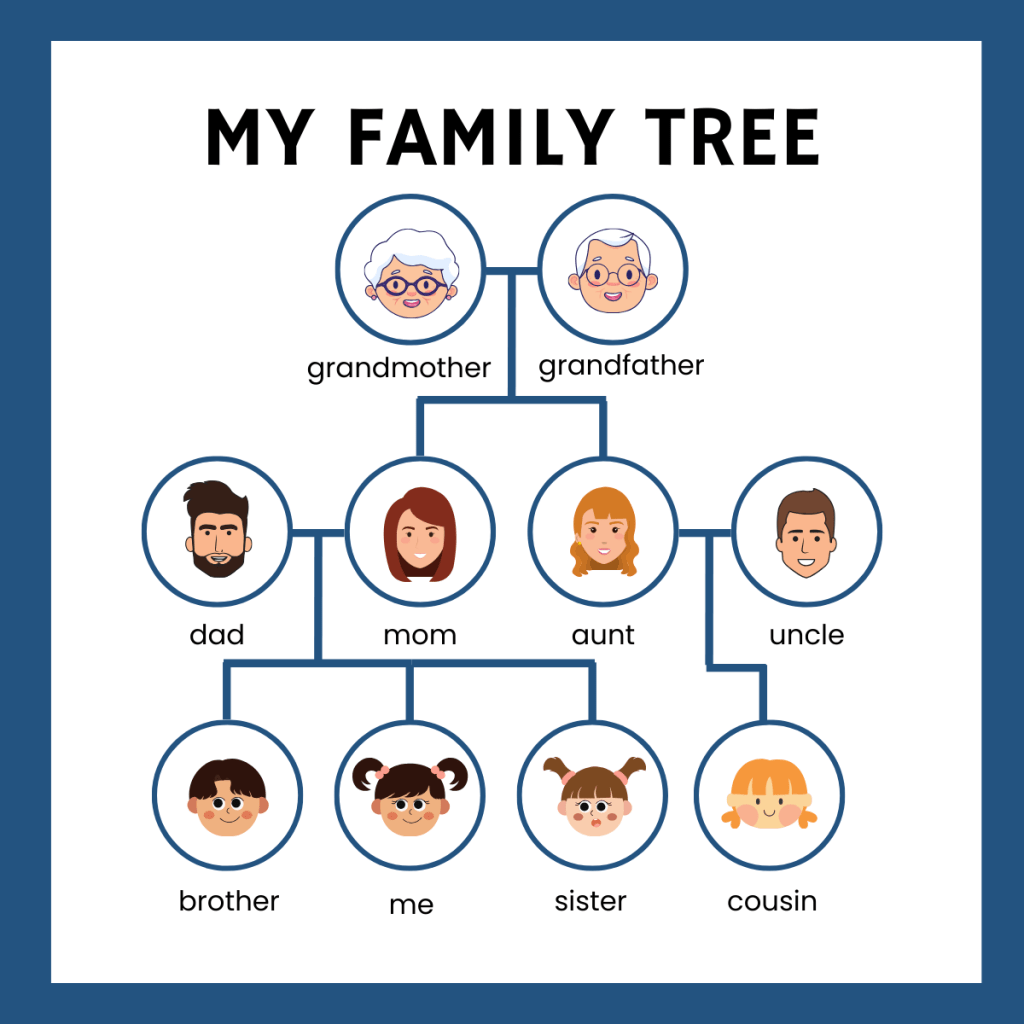
2. Vocabulary:
- Immediate Family:
- Father, mother, brother, sister.
- Extended Family:
- Grandfather, grandmother, uncle, aunt, cousin.
- Additional Relationships:
- Nephew, niece, son-in-law, daughter-in-law.
- Personality Adjectives:
- Kind, patient, outgoing, funny, responsible.
3. Useful Phrases:
- Describing Parents:
- My father is very patient.
- Her mother is incredibly kind.
- Talking about Siblings:
- My brother is outgoing and funny.
- She is the responsible one in the family.
- Extended Family:
- My grandparents live in the countryside.
- I often visit my aunt and uncle.
4. Read:
Meet my immediate family. My father is a kind and patient man. He always listens to my problems and gives the best advice. My mother is very responsible, taking care of the home and going to work. My elder brother is outgoing and funny; he can make anyone laugh. My younger sister is a little shy but very kind-hearted. Together, we make a happy and supportive family.
5. Conversation Questions:
- How would you describe your father’s personality?
- How would you describe your mother?
- Do you have any siblings? How would you describe their personalities?
- What qualities do you appreciate most in your family members?
- What do you enjoy doing with your family?
6. Practice:
- Describe Your Family:
- Write a short paragraph describing the personalities of your immediate family members.
- Role-Play:
- Practice a conversation where you introduce your family members and describe their personalities.
- Create Sentences:
- Create sentences using both family member vocabulary and personality adjectives.
7. Real-Life Application:
- Use these phrases in conversations about your family or when sharing stories with friends.
8. Reflection:
- Reflect on how adding personality adjectives enhances your descriptions of family members. Note any new words or expressions you’ve learned.
Part 2: Possessive Pronouns
1. Explanation: Possessive pronouns are words that indicate ownership or possession. They replace nouns to show to whom or to what something belongs. Understanding possessive pronouns is crucial for clear and concise communication.
2. Possessive Pronouns:
- Singular:
- Mine, yours, his, hers, its.
- Plural:
- Ours, yours, theirs.
3. How to Use Possessive Pronouns:
Possessive pronouns are used to indicate ownership or possession without repeating the noun. They replace nouns to show who or what something belongs to. Here’s a detailed explanation of how to use possessive pronouns:
Singular Possessive Pronouns:
- Mine:
- Example: The red car is mine.
- Yours:
- Example: Is this pen yours or his?
- His:
- Example: The book with the red cover is his.
- Hers:
- Example: The laptop is hers.
- Its:
- Example: The cat is sleeping; its tail is curled.
Plural Possessive Pronouns:
- Ours:
- Example: The responsibility for the project is ours.
- Yours:
- Example: Are these keys yours or theirs?
- Theirs:
- Example: The decision is theirs, not ours.
How to Use Possessive Pronouns:
- Replace a Noun:
- Use possessive pronouns to replace a previously mentioned noun to indicate ownership.
- Example: The red car is mine. (Replaces “my car”)
- Use possessive pronouns to replace a previously mentioned noun to indicate ownership.
- No Apostrophe:
- Unlike possessive nouns, possessive pronouns do not use an apostrophe.
- Example: The laptop is hers. (Not her’s)
- Unlike possessive nouns, possessive pronouns do not use an apostrophe.
- Clarity in Ownership:
- Possessive pronouns make sentences more concise and clear by avoiding repetition of nouns.
- Example: The book with the red cover is his. (Instead of “The book with the red cover is his book.”)
- Possessive pronouns make sentences more concise and clear by avoiding repetition of nouns.
- Ownership Emphasis:
- Possessive pronouns can emphasize ownership or possession in a sentence.
- Example: The decision is theirs, not ours.
- Possessive pronouns can emphasize ownership or possession in a sentence.
- Agreement with the Noun:
- Choose the possessive pronoun that agrees in gender and number with the noun it replaces.
- Example: The responsibility for the project is ours. (Agrees with the plural noun “responsibility”)
- Choose the possessive pronoun that agrees in gender and number with the noun it replaces.
Agreement with the Noun:
- Gender and Number:
- Possessive pronouns need to agree with the gender and number of the noun they replace.
- Example: His cat is black. (Agrees with the singular masculine noun “cat”)
- Example: Hers are blue. (Agrees with the plural feminine noun “eyes”)
- Possessive pronouns need to agree with the gender and number of the noun they replace.
- Neutral Possessive Pronoun:
- If the gender is unknown or irrelevant, use neutral possessive pronouns like “its” for singular and “theirs” for plural.
- Example: The dog is sleeping; its tail is wagging.
- If the gender is unknown or irrelevant, use neutral possessive pronouns like “its” for singular and “theirs” for plural.
Using Possessive Pronouns in Sentences:
- Basic Sentences:
- Example: This pen is mine.
- Comparisons:
- Example: Is this yours or hers?
- Ownership Statements:
- Example: The project’s success is ours.
- Emphasizing Ownership:
- Example: The decision is theirs, not ours.
4. Useful Phrases:
- Singular Possessive:
- That book is mine.
- Is this pen yours or his?
- Plural Possessive:
- The responsibility is ours.
- Are these keys theirs?
5. Fill-in-the-Blank Exercise:
Exercise: Change to Possessive Pronoun
- I met Mary’s dog yesterday. I met __________ dog yesterday.
- The book on the table is Emily’s. The book on the table is __________.
- The responsibility for the success of the project lies with John. The responsibility is __________.
- These toys belong to the children. These toys are __________.
- The beautiful painting belongs to the artist. The beautiful painting is __________.
- The decision about the budget is with the manager. The decision is __________.
- The keys to the car are with Susan. The keys are __________.
- The new house is owned by my family. The new house is __________.
- The laptop on the desk is the programmer’s. The laptop on the desk is __________.
- The letter was written by the secretary. The letter was written by __________.
Answer Key:
- I met Mary’s dog yesterday. I met her dog yesterday.
- The book on the table is Emily’s. The book on the table is hers.
- The responsibility for the success of the project lies with John. The responsibility is his.
- These toys belong to the children. These toys are theirs.
- The beautiful painting belongs to the artist. The beautiful painting is his.
- The decision about the budget is with the manager. The decision is his.
- The keys to the car are with Susan. The keys are hers.
- The new house is owned by my family. The new house is ours.
- The laptop on the desk is the programmer’s. The laptop on the desk is his.
- The letter was written by the secretary. The letter was written by her.
6. Practice:
- Create Sentences:
- Form sentences describing ownership using possessive pronouns.
- Story Writing:
- Write a short story using possessive pronouns to indicate ownership.
- Dialogue Practice:
- Engage in dialogues with a partner, incorporating possessive pronouns.
7. Real-Life Application:
- Use possessive pronouns in everyday conversations to express ownership or possession.
8. Reflection:
- Reflect on how possessive pronouns add clarity and conciseness to your expressions. Identify any challenges or areas for improvement.
9. Additional Challenge:
- Challenge yourself by incorporating possessive pronouns into more complex sentences or scenarios.
Part 3: Descriptive Adjectives to Describe People and Family
1. Explanation: In this lesson, we’ll explore descriptive adjectives used to characterize physical appearances, specifically focusing on family members. Using these adjectives enhances your ability to describe the looks of your loved ones.
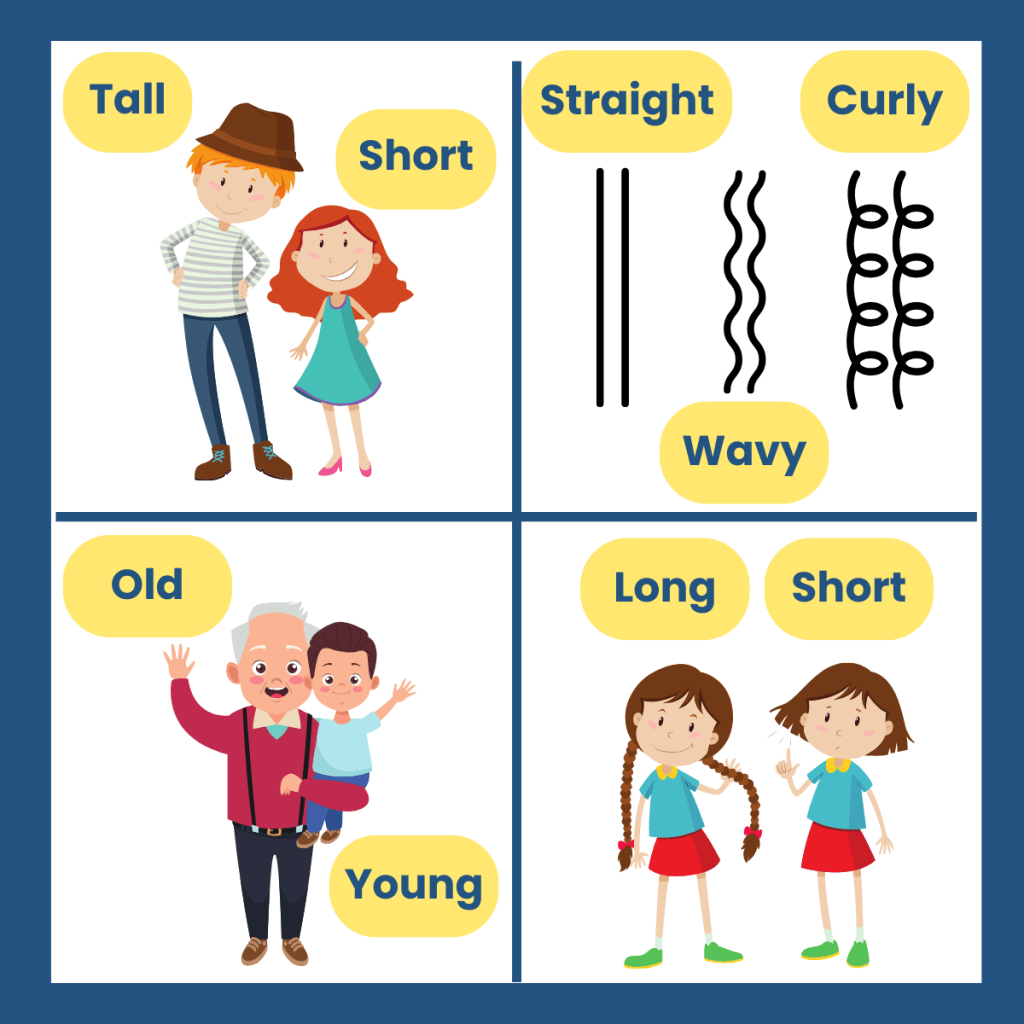
2. Vocabulary:
- Height:
- Tall, short, average height.
- Hair Color:
- Brown hair, blonde hair, black hair.
- Hair Length:
- Short hair, long hair, medium-length hair.
- Other Descriptive Adjectives:
- Slim, muscular, chubby, fair-skinned, dark-skinned.
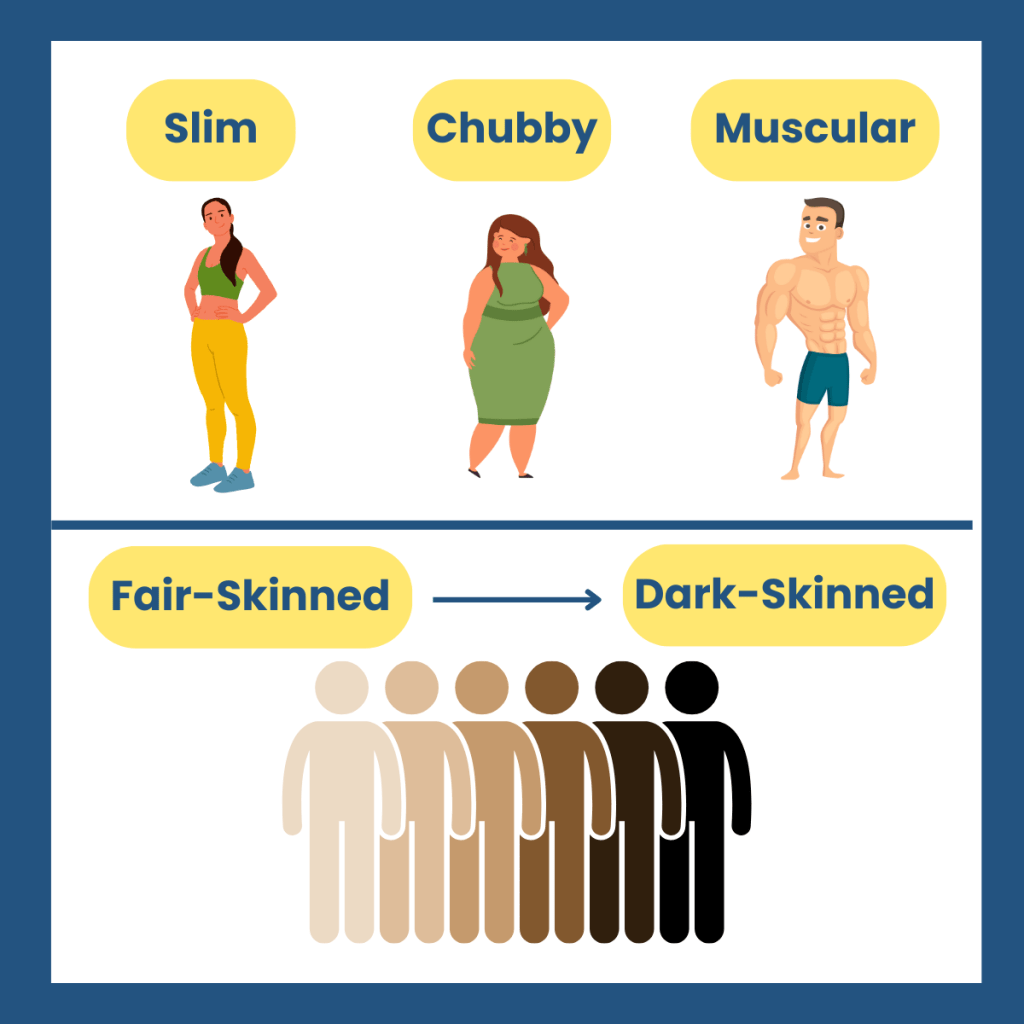
3. Short Simple Texts:
Meet my family! My father is tall with short black hair, while my mother is of average height with long brown hair. My older brother is slim and has blonde hair, and my younger sister is short with medium-length brown hair. We all share a close bond despite our different looks.
My cousin David is muscular with short, curly black hair. His wife, Sarah, is fair-skinned with long blonde hair. Their daughter, Lily, is a chubby, adorable toddler with big brown eyes.
4. Conversation Questions:
- Can you describe three of your family members?
- What color hair do your parents have?
- Do you look like any of your family members?
- Can you describe two of your friends?
- What do you look like?
5. Practice:
- Create Sentences:
- Practice describing your family members using the vocabulary.
- Picture Descriptions:
- Describe a family photo below or draw a family portrait, incorporating the adjectives.
- Role-Play:
- Engage in a conversation with a language partner, taking turns describing family members.

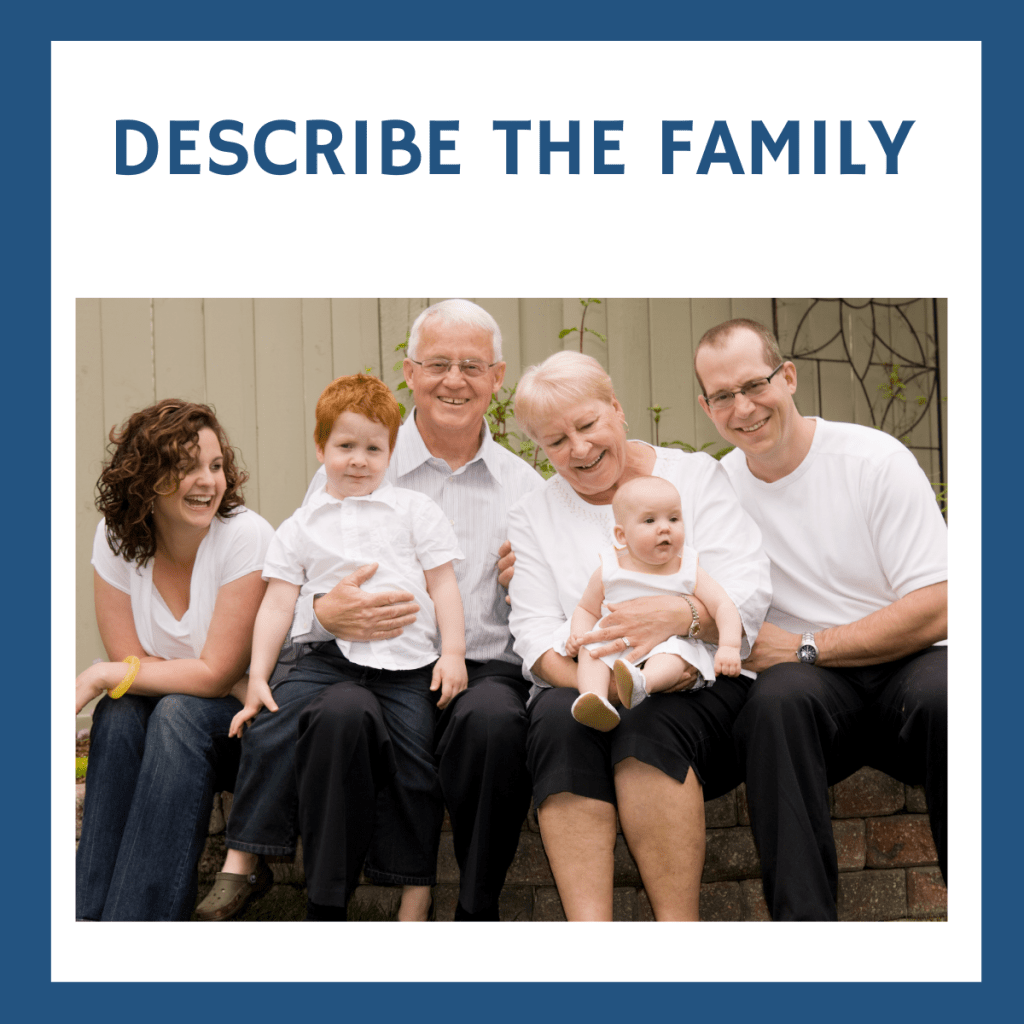

6. Real-Life Application:
- Use the descriptive adjectives learned when talking about family members in casual conversations or introductions.
7. Reflection:
- Reflect on how incorporating descriptive adjectives enriches your ability to convey information about your family’s physical appearances. Identify any new words or expressions you’ve learned.
8. Additional Challenge:
- Challenge yourself by using synonyms or expanding your vocabulary to describe more nuanced physical characteristics of family members.
Part 4: Listening Practice
Listen to the audio of these short dialogues then answer the questions that follow. Check your understanding with the answer key that follows.
Listening 1:
Comprehension Questions:
- How would you describe the sister’s height?
- What color is her hair?
- What did they do last weekend?
- Is the sister outgoing or shy?
Listening 2:
Comprehension Questions:
- How would you describe the father’s height?
- What color is the mother’s hair?
- How would you describe the younger brother?
- What did the family do last night?
Listening 3:
Comprehension Questions:
- Whose dog is it?
- Who does the car belong to?
- What does the mother own?
- Whose responsibility is organizing family events?
- What is emphasized about the love in the family?
Answer Key and Scripts: Listening Exercise
Audio Script 1: Describing a Family Member
Script:
“Let me tell you about my sister. She’s tall, with long brown hair that reaches her shoulders. She has a fair complexion and brown eyes. She’s very outgoing and always has a smile on her face. Last weekend, we went to the park together, and she played with my niece. It was a wonderful day.”
- How would you describe the sister’s height?
- Answer: Tall.
- What color is her hair?
- Answer: Brown.
- What did they do last weekend?
- Answer: Went to the park together.
- Is the sister outgoing or shy?
- Answer: Outgoing.
Audio Script 2: Family Portrait
Script:
“Imagine a family portrait. My dad is tall and has short black hair. My mom, on the other hand, is of average height with long brown hair. My younger brother has blonde hair and is quite slim. We all gathered for a family dinner last night, sharing stories and laughter.”
- How would you describe the father’s height?
- Answer: Tall.
- What color is the mother’s hair?
- Answer: Brown.
- How would you describe the younger brother?
- Answer: Slim.
- What did the family do last night?
- Answer: Gathered for a family dinner, sharing stories and laughter.
Audio Script 3: Possessive Pronouns in Action
Script:
“Let me introduce you to my family. This is my sister, and that adorable dog over there is hers. The tall gentleman is my father, and the car parked outside is his. My mother has a beautiful garden; the flowers are hers. The responsibility of organizing family events is ours. We’re a close-knit group, and the love we share is theirs.”
- Whose dog is it?
- Answer: Sister’s.
- Who does the car belong to?
- Answer: Father’s.
- What does the mother own?
- Answer: Garden and flowers.
- Whose responsibility is organizing family events?
- Answer: Ours.
- What is emphasized about the love in the family?
- Answer: It’s theirs.
Lesson 6
Part 1: Hobbies and Leisure Time with Likes and Dislikes
1. Explanation: In this lesson, we’ll explore the world of hobbies and leisure time activities. Additionally, we’ll learn how to express likes and dislikes when talking about these interests.
2. Vocabulary: Hobbies and Leisure Time
- Common Hobbies:
- Reading, writing, drawing, painting, playing sports, playing musical instruments, gardening, cooking, hiking, watching movies, dancing, photography.
- For more hobbies vocabulary and picture dictionaries, check out the Vocabulary section on My English Place. https://myenglishplace.com/vocabulary/
- Likes and Dislikes Phrases:
- Like, love, enjoy, dislike, hate, not a fan of.
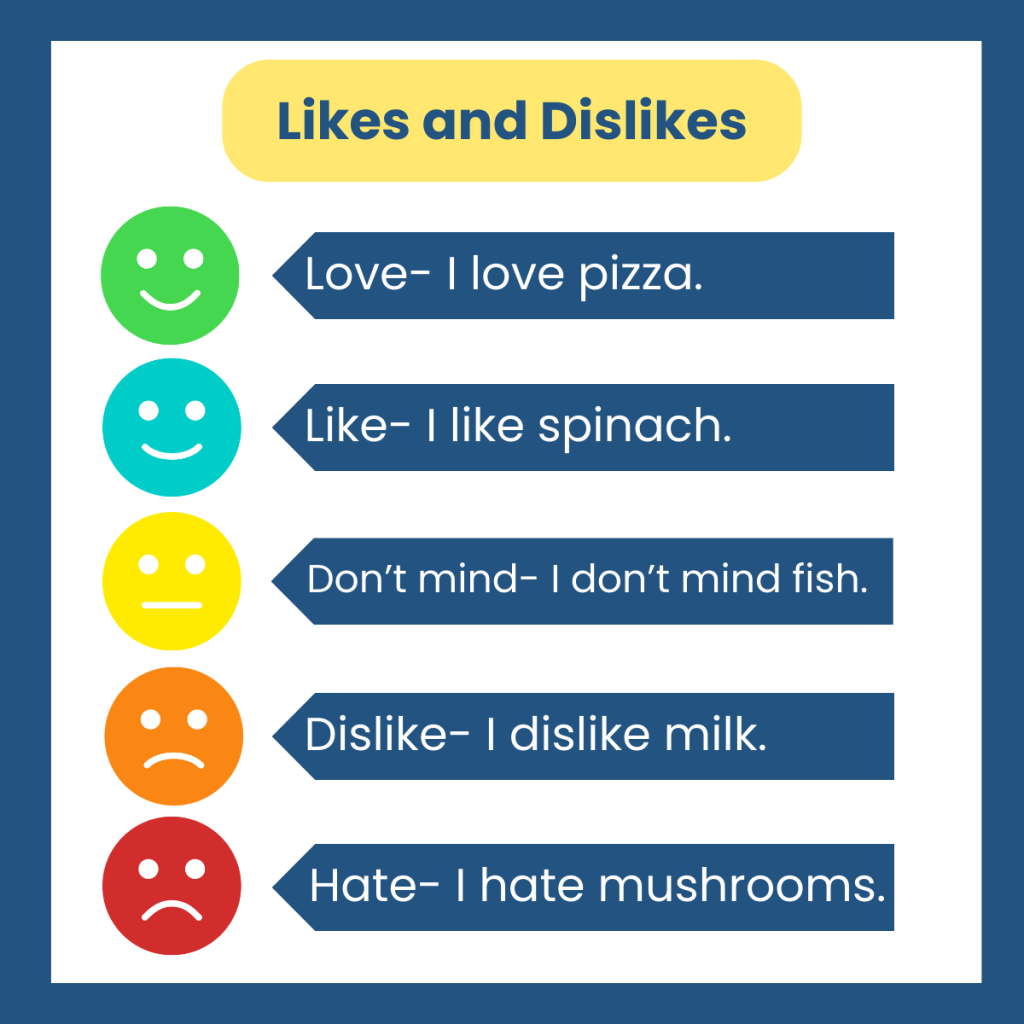
3. Short Simple Texts:
Text 1: Likes “Hi, it’s Jessica. I love spending my leisure time reading books. I enjoy the feeling of getting lost in a good story. Besides reading, I like hiking in nature. The fresh air and the beauty of the outdoors are something I truly enjoy.”
Text 2: Dislikes “Hey, this is Mike. I’m not a fan of cooking. It’s just not my thing. I also dislike gardening; the idea of getting my hands dirty doesn’t appeal to me. However, I love playing sports. It’s a great way for me to stay active and have fun.”
4. Conversation Questions:
- What hobbies do you enjoy in your leisure time?
- Why do you like them?
- Are there any hobbies you dislike or are not a fan of?
- What don’t you like about them?
- Do you have any new hobbies you’d like to try?
- What interests you about those hobbies?
- What hobbies do your family members have?
- How often do you do your hobbies?
5. Practice:
- Write About Your Hobbies:
- Write a short paragraph about your favorite hobbies, expressing why you like them.
- Express Likes and Dislikes:
- Practice using the vocabulary of likes and dislikes in sentences related to hobbies.
- Role-Play:
- Engage in a conversation with a language partner, discussing your hobbies, likes, and dislikes.
6. Real-Life Application:
- Use the phrases for expressing likes and dislikes when discussing hobbies in everyday conversations.
7. Reflection:
- Reflect on how expressing likes and dislikes adds depth to conversations about hobbies. Identify any new words or expressions you’ve learned.
8. Additional Challenge:
- Challenge yourself by learning vocabulary related to a new hobby you’d like to try or explore.
Part 2: Preferences, Hobbies, and Conjunctions (and, or, but)
1. Explanation: In this lesson, we’ll focus on expressing preferences related to hobbies. Additionally, we’ll explore the use of conjunctions (and, or, but) to connect ideas and express choices.
2. Conjunctions: And, Or, But
- And: Used to connect similar ideas or actions.
- Example: I like reading books and watching movies.
- Or: Used to present alternatives or choices.
- Example: I can either go for a walk or stay at home.
- But: Used to introduce a contrasting idea or action.
- Example: I like cooking, but I don’t enjoy cleaning up afterward.
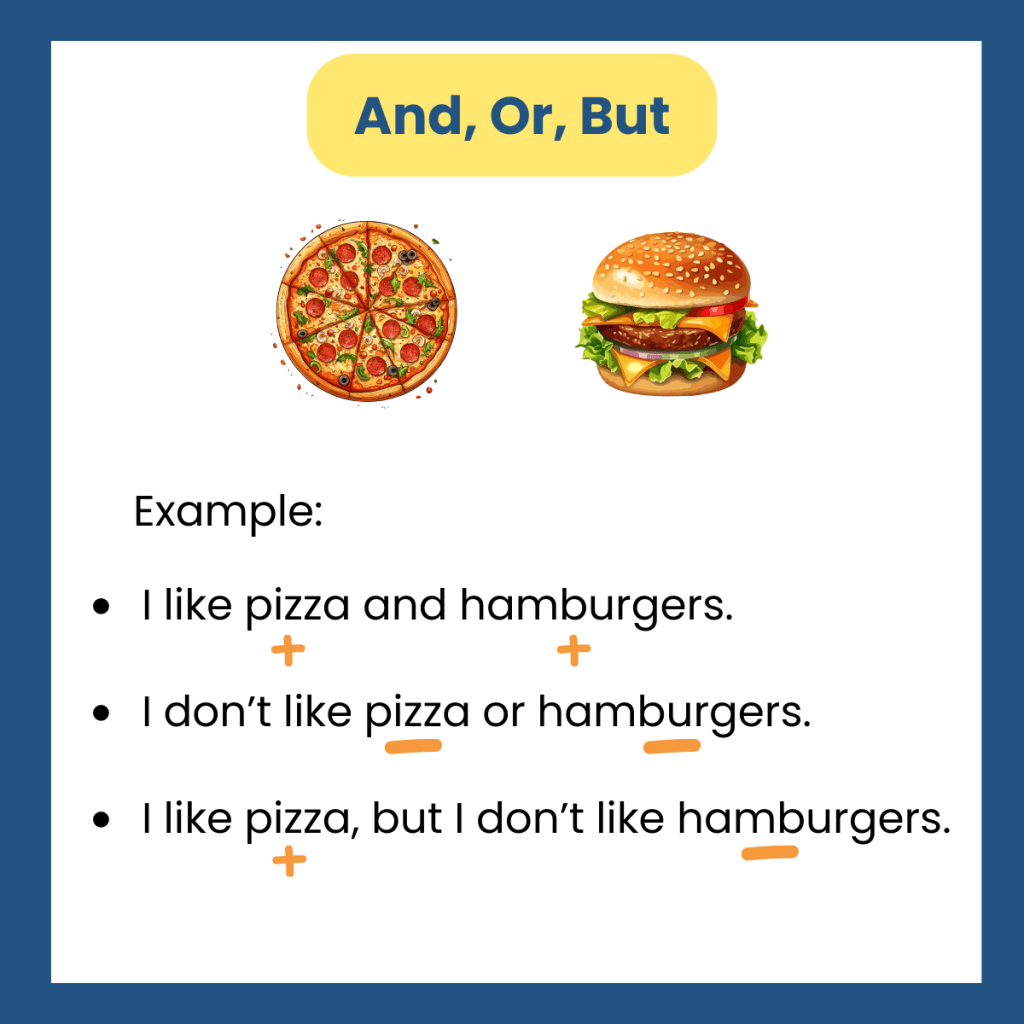
3. Detailed Explanation:
- And: Combines two similar ideas.
- Example: She likes swimming and hiking.
- Or: Presents a choice between two options.
- Example: I can play the guitar or the piano.
- But: Introduces a contrasting idea.
- Example: He enjoys playing video games, but he doesn’t like watching TV.
4. Dialogues:
Lisa and Alex are talking about their hobbies.
Lisa: Hi, Alex! What do you like to do in your free time?
Alex: Hey, Lisa! I like drawing, and I also enjoy playing video games.
Lisa: That’s cool! I love painting, and I also like playing the guitar.
Alex: Nice! Painting and playing the guitar sound fun. Do you do them every day?
Lisa: Yes, I do. They help me relax. How about you?
Alex: I draw when I want to be creative, and playing video games is my way to relax.
Lisa: That’s great! We both have hobbies that make us happy.
Dialogue 2: Preferences using “Or” and “But”
Mark and Sarah are discussing their plans for the evening.
Mark: Hi, Sarah! What do you feel like doing tonight?
Sarah: Hey, Mark! I will either watch a movie or go for a walk in the park.
Mark: I like watching movies, but I don’t enjoy walking that much.
Sarah: No problem! We can stay indoors. I have a new book too. You can either read with me or play games on your phone.
Mark: Reading sounds good. I like quiet activities, but I’m not a big fan of games on the phone.
Sarah: Alright, let’s read then. It’s relaxing, and I enjoy it too.
Mark: Perfect! Let’s do that.
5. Practice:
- Create Sentences:
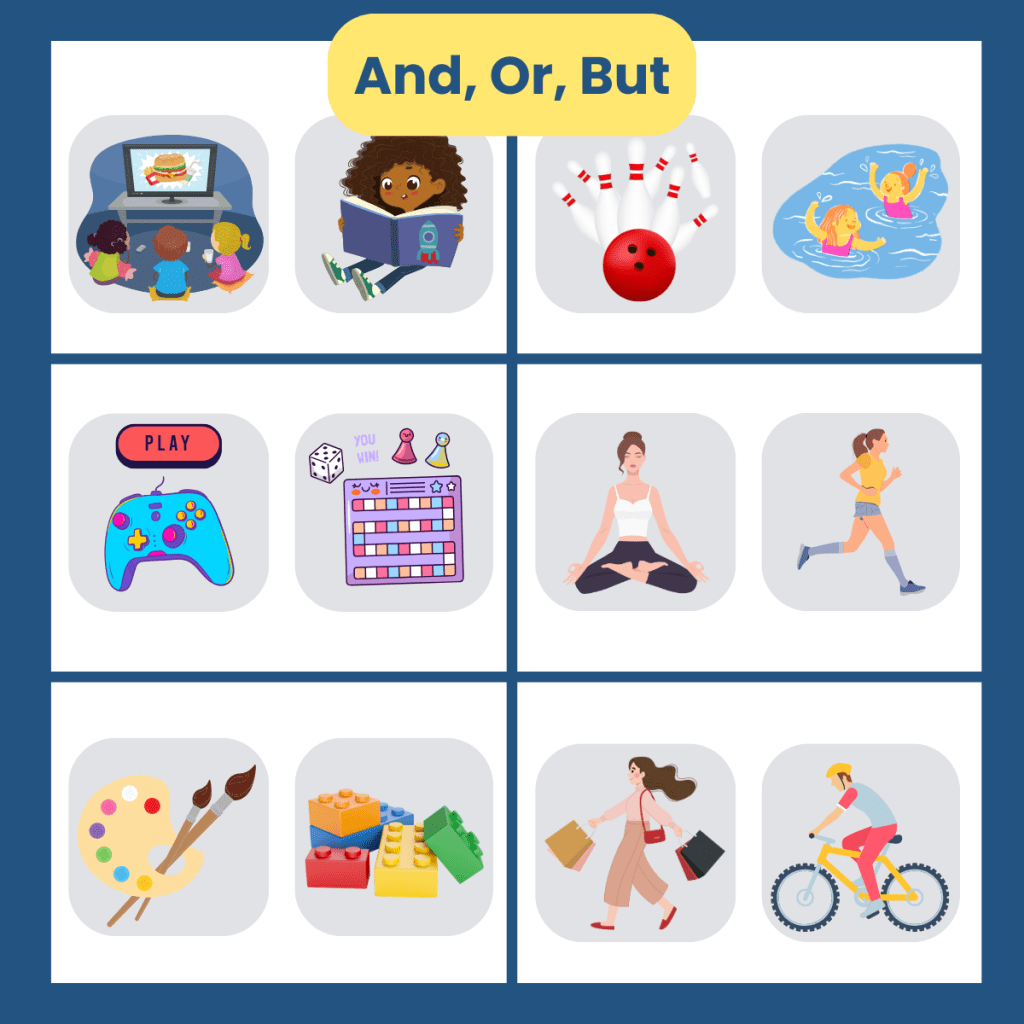
- Look at the image below. Practice using “and,” “or,” and “but” to connect preferences and hobbies in sentences.
- Example: I like reading, but I don’t like watching TV.
- Express Your Preferences:
- Write about your own hobbies and preferences using conjunctions.
- Role-Play:
- Engage in a conversation with a language partner, discussing your preferences and choices using conjunctions.
6. Real-Life Application:
- Use conjunctions when describing your preferences and making choices in everyday conversations.
7. Reflection:
- Reflect on how using conjunctions adds nuance and complexity to expressing preferences. Identify any new words or expressions you’ve learned.
8. Additional Challenge:
- Challenge yourself by creating more complex sentences that involve multiple preferences and choices using conjunctions.
Part 3: Prepositions of Time – “At, On, In”
1. Explanation:
This lesson will guide you in using prepositions of time – “at, on, in” – when discussing hobbies and planned activities. Correct usage of these prepositions is essential for expressing when events or activities are scheduled.
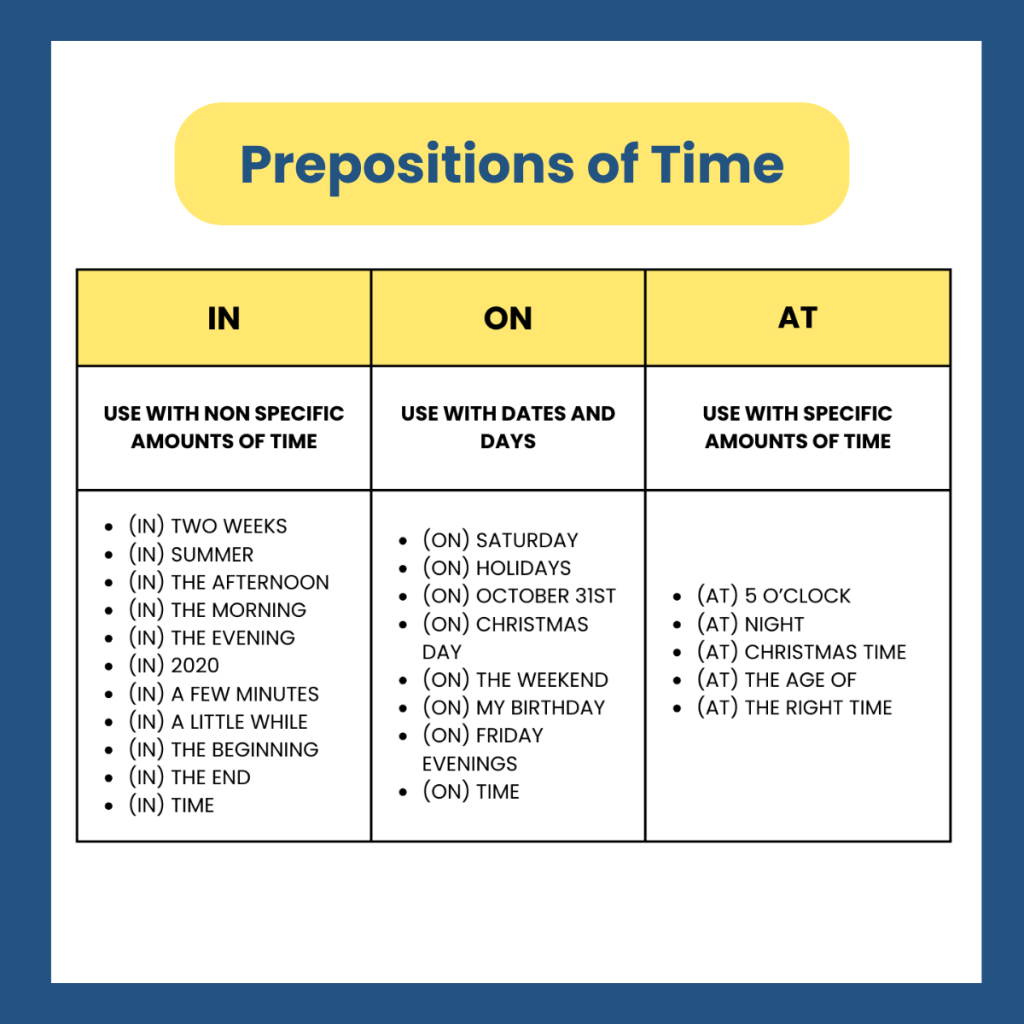
2. Prepositions of Time – “At, On, In”:
- At: Used for specific points in time.
- Example: I have a meeting at 2 PM.
- On: Used for days and dates.
- Example: I have an appointment on Monday.
- In: Used for longer periods, months, seasons, and years.
- Example: I’ll go on vacation in July.
3. Study the Table Below:
4. Short Texts:
Text 1:
“Hi there, it’s Sarah. I have a yoga class at 9 AM every Saturday. It’s a great way to start the weekend. I also take dance classes on Tuesdays at 4 PM and guitar lessons on Fridays at 6 PM.”
Text 2:
“Hello, this is Alex. I work on my novel on Sundays in the morning. It’s a quiet day, perfect for writing. Also, I take a photography class on Saturdays afternoons. In October, we’ll learn how to photograph autumn scenes.”
5. Practice:
- Choose three different hobbies or activities and create sentences using “at,” “on,” and “in.”
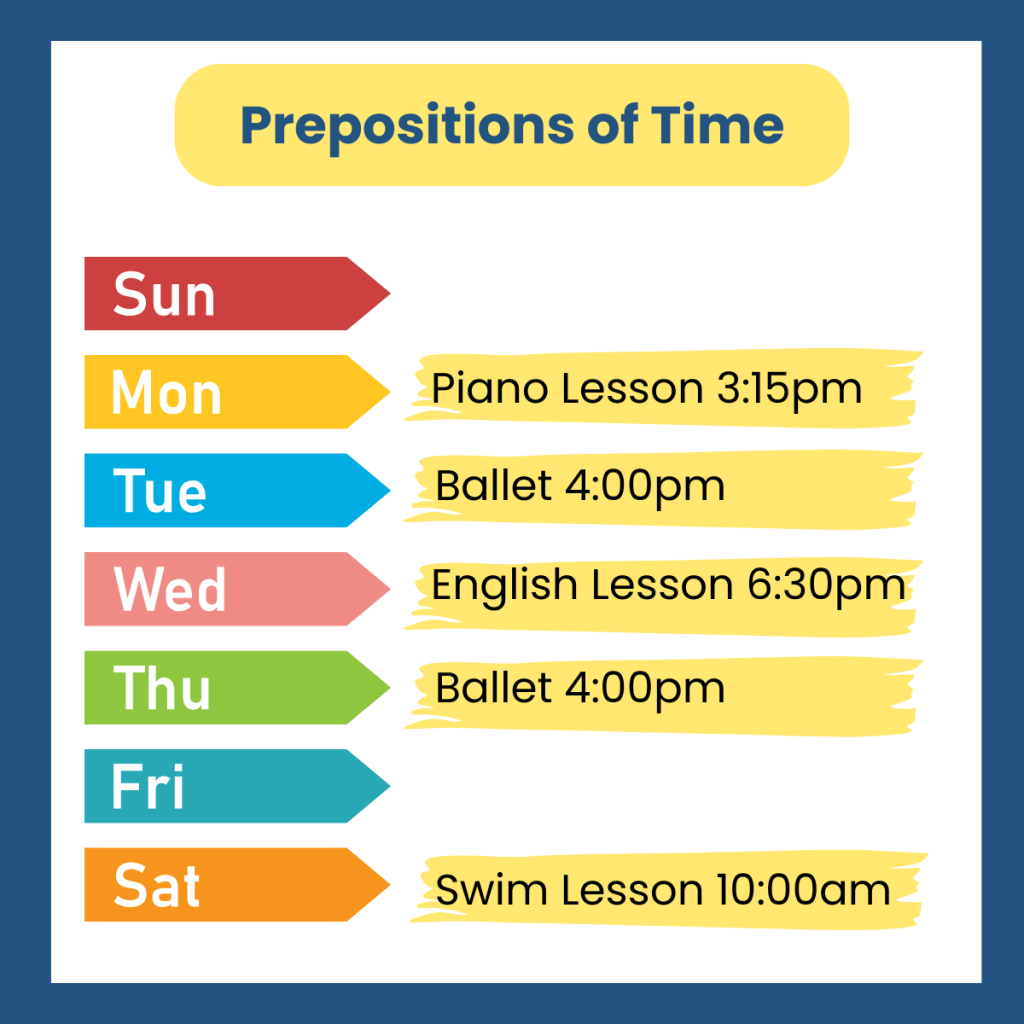
- Using the image below, create sentences using “at,” “on,” and “in” for scheduled events.
6. Real-Life Application:
- Utilize these prepositions when talking about your weekly schedule, making plans, or discussing future events.
7. Reflection:
- Reflect on how using the correct preposition enhances the clarity of your sentences when discussing the timing of hobbies and planned activities.
8. Additional Challenge:
- Create a longer paragraph describing a week that includes various activities, incorporating “at, on, in” appropriately.
Part 4: Listening Practice
Listen to the audio of these short dialogues then answer the questions that follow. Check your understanding with the answer key that follows.
Listening 1:
Comprehension Questions:
- What is Mark’s hobby?
- When does Mark play the guitar?
- When is Lily’s painting time?
- What does Lily do before going to bed?
Listening 2:
Comprehension Questions:
- What does Alex like doing on Wednesdays?
- What is something Alex doesn’t like?
- When does Emma cook for her family?
- What doesn’t Emma like doing?
Listening 3:
Comprehension Questions:
- When does Jack’s photography class meet?
- When does Jack go hiking?
- When does Sofia work on her art projects?
- When does Sofia take a painting class?
Answer Key and Scripts: Listening Exercise
Audio Script 1: Hobbies and Leisure Time
Script:
Speaker 1: Hi, it’s Mark. I love playing the guitar. I play the guitar at home in the evening at 7 PM. I also like watching movies. I do that on Saturdays. It’s my special movie night.
Speaker 2: Hi, this is Lily. I enjoy painting. I do it in my free time on Sundays. It helps me relax. I also read books. I do that at night before going to bed.
- What is Mark’s hobby?
- Answer: Playing the guitar.
- When does Mark play the guitar?
- Answer: In the evening, around 7 PM.
- When is Lily’s painting time?
- Answer: On Sundays.
- What does Lily do before going to bed?
- Answer: She reads books.
Audio Script 2: Likes and Dislikes in Hobbies
Script:
Speaker 1: Hey, it’s Alex. I really like playing basketball, but I hate swimming. I play basketball on Wednesdays with my friends. It is so much fun.
Speaker 2: Hi there, this is Emma. I love cooking. I cook on Fridays for my family. I also like jogging. I usually jog in the morning, but I don’t like waking up early.
- What does Alex like doing on Wednesdays?
- Answer: Playing basketball.
- What is something Alex doesn’t like?
- Answer: Swimming.
- When does Emma cook for her family?
- Answer: On Fridays.
- What doesn’t Emma like doing?
- Answer: Waking up early.
Audio Script 3: Prepositions of Time with Hobbies
Script:
Speaker 1: Hello, it’s Jack. I have a photography class at the park every Sunday at 10 AM. I also love to go hiking. I do it in the summer with my friends.
Speaker 2: Hi, this is Sofia. I love art. I work on my art projects in the evenings. My favorite time is at 6 PM. I also take a painting class on Sundays.
- When does Jack’s photography class meet?
- Answer: Every Sunday at 10 AM.
- When does Jack go hiking?
- Answer: In the summer.
- When does Sofia work on her art projects?
- Answer: In the evenings, at 6 PM.
- When does Sofia take a painting class?
- Answer: On Sundays.
Lesson 7
Part 1: Countable and Uncountable Nouns
1. Explanation:
In this lesson, we’ll look into the difference between countable and uncountable nouns, understanding when to use “some” and “any” with each category. This knowledge is crucial for accurate communication about quantities.
2. Using Countable and Uncountable Nouns with Food and Drinks:
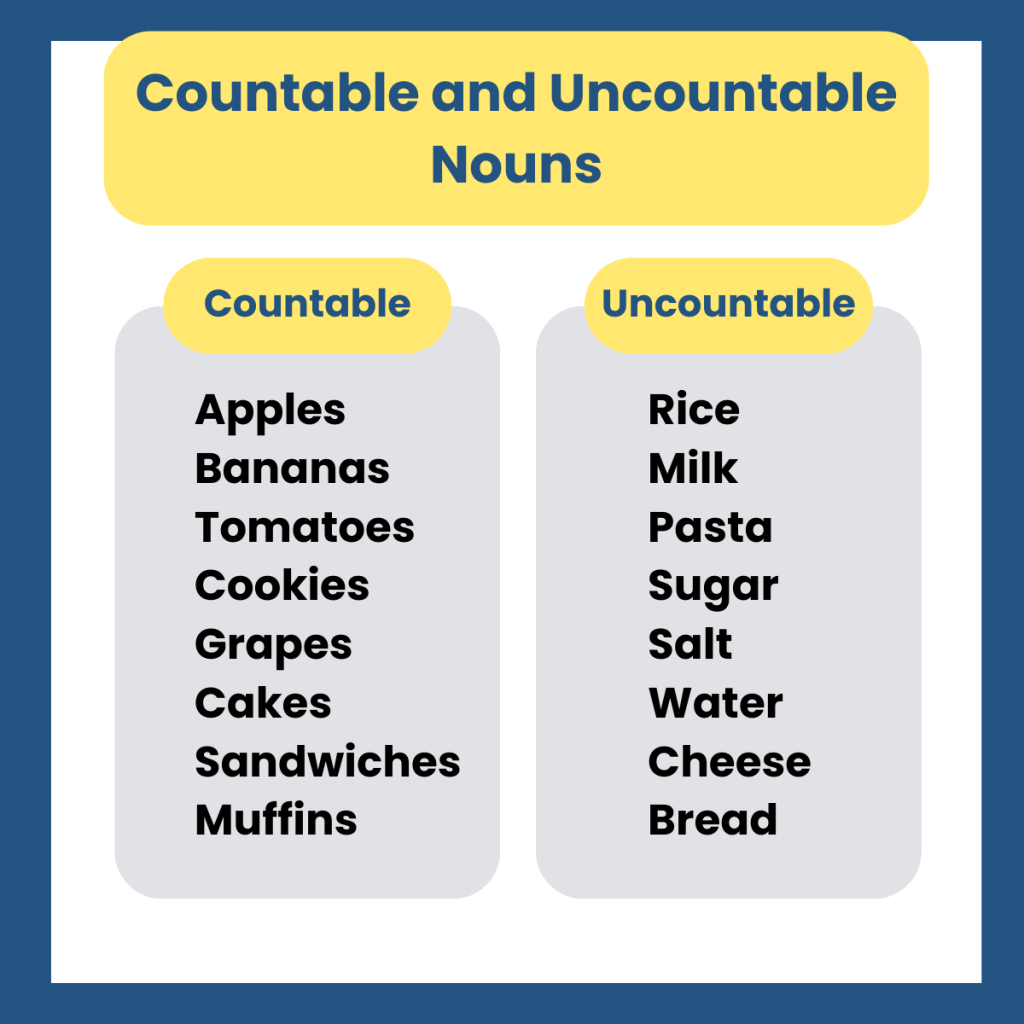
- Countable Nouns: Use countable nouns when referring to items that can be counted.
- Example: There are three cakes on the table.
- Additional Examples:
- She ate two cookies.
- We bought five oranges.
- Uncountable Nouns: Use uncountable nouns when referring to substances or items that cannot be counted as separate units.
- Example: I need some milk.
- Additional Examples:
- She enjoys drinking tea.
- Can I have a little sugar?
3. Using Some and Any with Countable and Uncountable Nouns:
Some:
Usage:
- Affirmative Sentences: “Some” is used in positive or affirmative sentences when we talk about a certain amount or quantity. It implies that there is a quantity, but it doesn’t specify the exact number.
- Examples:
- I bought some apples at the store.
- There are some interesting books on the shelf.
- Examples:
Any:
Usage:
- Questions: “Any” is often used in questions when we are asking about the presence or absence of something. It is used with both countable and uncountable nouns.
- Examples:
- Do you have any plans for the weekend?
- Is there any milk in the fridge?
- Examples:
- Negative Sentences: “Any” is used in negative sentences to indicate the absence or lack of something. Again, it can be used with both countable and uncountable nouns.
- Examples:
- There isn’t any coffee left.
- She doesn’t have any siblings.
- Examples:
Key Points:
- Affirmative vs. Negative/Question: The primary distinction between “some” and “any” lies in the context. “Some” is used in affirmative sentences when the quantity is present, while “any” is used in questions and negative sentences to inquire about or state the absence of quantity.
- Countable and Uncountable: Both “some” and “any” can be used with both countable and uncountable nouns. For example, you can say, “Do you have any books?” (countable) or “Do you have any water?” (uncountable).
- Level of Formality: In more formal contexts, especially in positive statements, “some” may be replaced by phrases like “a few” (for countable) or “a bit of” (for uncountable). However, in everyday conversation, “some” is commonly used in both formal and informal settings.
4. Short Texts:
Text 1: Countable Nouns
“Hi, it’s Alex. I bought some apples and bananas today. There are three cakes in the kitchen. I also got a few bottles of water for the party.”
Text 2: Uncountable Nouns
“Hello, this is Sarah. I made some pasta for dinner. Can you pass me the salt? I’d like to add a little to my soup. Also, there’s some juice in the fridge if you’re thirsty.”
5. Practice:
- Identify whether the following nouns are countable or uncountable: rice, tomatoes, cheese, coffee, bread, bananas, and salt.
- Write sentences using countable nouns and uncountable nouns to describe your breakfast.
- Share your sentences with a language partner and discuss the differences between countable and uncountable nouns.
6. Real-Life Application:
- Apply the knowledge of countable and uncountable nouns when shopping for groceries or ordering food at a restaurant.
7. Reflection:
- Reflect on how understanding countable and uncountable nouns improves your accuracy in expressing quantities.
8. Additional Challenge:
- Create a short dialogue discussing a meal, incorporating both countable and uncountable nouns appropriately.
Part 2: Ordering in a Restaurant
1. Explanation: Ordering in a Restaurant
In this lesson, we’ll focus on the essential language skills required for ordering food and drinks in a restaurant. Additionally, we’ll integrate the use of countable and uncountable nouns, as well as the appropriate use of “some” and “any.”
2. Useful Phrases:
- Asking for Recommendations:
- What do you recommend?
- Could you suggest a popular dish?
- What’s your specialty?
- Ordering:
- I’ll have the chicken curry, please.
- Can I get a glass of water?
- May I have some bread, please?
- Confirming:
- Is the salad included?
- Does the dish come with rice?
3. Dialogue 1: Ordering a Meal
Server: Good evening! Welcome to Blue Fins Restaurant. Are you ready to order?
Customer: Yes, thank you. What do you recommend?
Server: Our chef’s special is the grilled salmon, and the pasta is also quite popular.
Customer: I’d like the grilled salmon, please. Does it come with any sides?
Server: Yes, it comes with your choice of salad or soup. Which would you prefer?
Customer: I’ll have the salad, please.
4. Dialogue 2: Ordering Drinks and Dessert
Server: How was your main course? Ready for dessert or perhaps a drink?
Customer: Everything was delicious. I’d like to order a coffee, please.
Server: Certainly. Would you like some dessert with that?
Customer: Yes, I’ll have the chocolate cake, please.
Server: Great choice. Anything else?
Customer: Could I get some water too, please?
5. Practice:
- Create your own dialogue where you order a meal, including a drink and dessert.
- Write down phrases you would use to ask for recommendations, confirm details, and express your preferences.
6. Real-Life Application:
- Practice ordering in a restaurant with a friend or language partner. Use the phrases and expressions learned in this lesson.
7. Reflection:
- Reflect on how using specific language when ordering enhances your dining experience and communication.
8. Additional Challenge:
- Imagine a scenario where you have dietary restrictions or preferences. Create a dialogue where you communicate these needs to the server while ordering.
Part 3: At a Cafe
1. Explanation: At a Cafe
This lesson will guide you through common phrases and dialogues for ordering food and drinks at a cafe. Additionally, we’ll integrate the topic of expressing preferences to make your experience more personalized.
2. Useful Phrases:
- Ordering:
- I’d like a cappuccino, please.
- Can I get a croissant with that?
- May I have a slice of cheesecake?
- Expressing Preferences:
- I prefer my coffee with less sugar.
- I’m a fan of strong, black coffee.
- I’d rather have my sandwich without mayonnaise.
3. Dialogue 1: Ordering Coffee and a Pastry
Server: Hi there! What can I get you today?
Customer: Good morning. I’ll have a latte, please. And could I get a blueberry muffin with that?
Server: Of course. Would you like your latte with any sweeteners?
Customer: Just a little sugar, please.
4. Dialogue 2: Expressing Preferences for a Sandwich
Server: Welcome! What can I do for you?
Customer: Hi. I’m in the mood for a turkey sandwich. Can I get that with no mayonnaise, please?
Server: Certainly. Is there any specific type of bread you prefer?
Customer: Whole wheat, please. And can I have it toasted?
5. Practice:
- Create your own dialogue where you order a drink and pastry, expressing preferences.
- Write down phrases you would use to customize your order, specifying preferences for taste, sweetness, or ingredients.
6. Real-Life Application:
- Visit a local cafe or practice with a friend, incorporating the phrases learned in this lesson to express your preferences.
Part 4: Listening Practice
Listen to the audio of these short dialogues then answer the questions that follow. Check your understanding with the answer key that follows.
Listening 1:
Comprehension Questions:
- What did the customer order for the main course?
- Did the customer want any sides? If yes, what did they choose?
- What drink did the customer request?
Listening 2:
Comprehension Questions:
- What did the customer order at the cafe?
- Did the customer ask for anything to go with the latte? If yes, what was it?
- How much sugar did the customer want in their latte?
Listening 3:
Comprehension Questions:
- What did the customer order at the restaurant?
- Did the customer want mayonnaise on their sandwich?
- What type of bread did the customer prefer?
Answer Key and Scripts: Listening Exercise
Audio Script 1: Ordering at a Restaurant
Script:
Server: Welcome to the Blue Spoon restaurant! Are you ready to order?
Customer: Yes, thank you. I’ll have the chicken pasta, please.
Server: Great choice. Would you like any sides with that?
Customer: Yes, I’d like a side salad, please.
Server: Sure thing. Anything to drink?
Customer: Can I get a glass of water, please?
- What did the customer order for the main course?
- Answer: The customer ordered the chicken pasta.
- Did the customer want any sides? If yes, what did they choose?
- Answer: Yes, the customer wanted a side salad.
- What drink did the customer request?
- Answer: The customer requested a glass of water.
Audio Script 2: Ordering at a Cafe
Script:
Barista: Hello! What can I get you today?
Customer: Hi there. I’ll have a latte, please. And can I also get a chocolate croissant?
Barista: Absolutely. Would you like any sugar in your latte?
Customer: Just a little, please.
- What did the customer order at the cafe?
- Answer: The customer ordered a latte and a chocolate croissant.
- Did the customer ask for anything to go with the latte? If yes, what was it?
- Answer: Yes, the customer asked for a chocolate croissant.
- How much sugar did the customer want in their latte?
- Answer: The customer wanted just a little sugar in their latte.
Audio Script 3: Expressing Preferences about Food
Script:
Server: Good afternoon! What can I get you?
Customer: Hi. I’m in the mood for a sandwich. I’ll have the turkey sandwich, please, but no mayonnaise.
Server: Certainly. Any preference for the type of bread?
Customer: Whole wheat, please. And can you toast it?
- What did the customer order at the restaurant?
- Answer: The customer ordered the turkey sandwich.
- Did the customer want mayonnaise on their sandwich?
- Answer: No, the customer did not want mayonnaise on their sandwich.
- What type of bread did the customer prefer?
- Answer: The customer preferred whole wheat bread.
 My English Place